A guest contribution to revdanbalsdon.com from Mel Leech, member at Felpham Methodist Church, West Sussex.
After the cancellation of the London Marathon people began doing 26 things…26 circuits of their gardens, 26 press ups… Mel was thinking that the alphabet has 26 letters and came up with 26 things that we could pray for or give thanks for during lock-down. (In fact Mel ended up with more than 26!)
A-Z Prayer
A The Ambulance Service will not be over-whelmed.
B Bus Drivers will be protected and the Bereaved will be comforted.
C Carers working in Care-homes will be recognised for all that they do.
D Doctors and Delivery drivers – both so important, and needing our prayers
E The Elderly will not be forgotten and have the care they need.
F Friends and Family: show them in any way we can how much they are appreciated
G Give thanks for our Gardens and pray for those who don’t have one. Grandparents missing their Grandchildren
H Health visitors as they continue to visit the vulnerable.
I Intensive Care Units and the patients being treated and the staff caring for them.
J Newly qualified Junior doctors and nurses who have been ‘thrown in the deep-end’.
K Be Kind to each-other (no need to say more)
L Lord ‘what are we to Learn from all this?’
M People’s Mental Health – and those who find Isolation particularly difficult.
N Contact with Neighbours and seeing they are in need of anything we can help them with and of course continue to pray and give thanks for our NHS.
O Give thanks that One Day this will come to an end.
P Paramedics as they work on the front-line bringing help as fast as they can. Remember the Prime Minister as he continues to fully recover and copes with the responsibilities of his job.
Q Pray Quarantine measures will continue to work. Pray for the Queen and that her faith will inspire and encourage the nation.
R There is a sufficient supply of Respirators.
S Supermarket shop-workers and those who are ‘shielding’ because of health issues.
T Give thanks for the Telephone to keep in contact with each-other. Teachers as they try to continue to give lessons ‘on-line’.
U Let’s show ‘Understanding’
V Give thanks for those ‘Volunteers’ doing all they can to help the NHS, Farmers and Delivering necessary food parcels and medical supplies etc.
W Thanks for daily Walks
X Pray a ‘Vaccination’ will soon be found.
Y Young people – including children, at this, what must be, a very strange time for them.
In this week’s reflections (available in audio and text), I think about a time I felt vulnerable and our own being faced with vulnerability as Covid-19 continues to present such a real threat to humanity.
NB – Dates of performance should be 2006 – Not sure how I got 2014 in my head when I recorded this!
Around this time of year 14 years ago, aged 14 I got gastroenteritis and stayed of school for a week. it was the first time in my life I’d missed school for so long, and it happened that it meant I missed the long awaited auditions for the School’s next show.
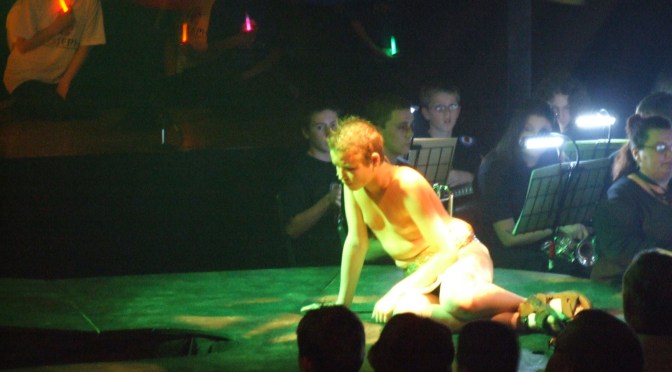
In November 2006, the school was to perform Joseph and the Amazing Technicolour Dreamcoat. Having not been in any previous shows, I was hoping I might get a part, and was disappointed I was too ill to audition. The next week, I went back to school and had settled that I’d miss out but to my surprise, despite missing auditions, the drama teachers allowed me to audition late, and by the end of the week I had not only got a part… I’d got the main part. I was going to play Joseph. My friends joked saying it was because I was the only year 10 who could still hit high notes.
We began rehearsals, had the summer holidays and then got back to it as term recommenced in September, and so did costume making. I’d not given costume any thought until suddenly I was presented with a gold belt and a white piece of fabric, about a foot deep and 4 feet long and told here’s your costume.
To this now just turned 15 year old, who had only just hit puberty, wasn’t the fittest, wasn’t the most attractive, and was a regular target for bullying – this was not just some costume. This was going to be brutal. I was being asked to stand on stage in front of my classmates (and those at the time I definitely wouldn’t call mates), in the equivalent of a white mini-skirt with a golden belt, and nothing else on.
Alas, I didn’t get as much bullying as I’d expected I might, but stepping out on stage the first time I felt incredibly vulnerable, conscious I was stood wearing, what felt like almost nothing, in front of my peers and teachers, and aware that I would have 6 performances to go, including performing in front of Sir Tim Rice when he came to open the school’s new music block that month.
As performance week loomed I then discovered not only did I need to come to terms with such a scantily clad costume, I also needed to be caked in makeup from head to waist. Each evening as we prepared for the show, some of my friends had the honourable responsibility of helping me ‘orange-up’ ready for performances.
Vulnerability was somewhat thrust upon me. Part of it was rational, perhaps part not. Some of it was through the behaviour of others, some was through my own fear. Some was simply part of being human. Some was my struggle with my own self-image.
My biggest regret of that time is that I don’t have a recording of the show. I never had a chance to watch myself back, and years later would love to be able to watch and remind myself of what I achieved as I embraced the vulnerability required of my 14 and 15yr old self.
In Acts 9, for Saul as he travels on the road, free and powerful, on a mission to ‘take down’ the followers of The Way, he is blinded and can go on no longer without the help of others. Suddenly, Saul’s life changes as he has to suddenly come to terms with his new found vulnerability.
I know from many conversations that in the last 2 months, in different and varied ways, many of us have needed to come to terms with our vulnerability. Whether or not our age or health increases our vulnerability, all humanity is vulnerable right now. We have all had to face that vulnerability, changing the way we live, asking others to help us, to care for ourselves and our communities.
This is not easy. Much like Saul, we live in relative freedom, used to being able to do and go where we want when. Ongoing suffering, grief and struggle is part of the vulnerable reality this pandemic forces humanity as a whole to hold and bear.
But to become vulnerable does not mean all is lost. In the midst of our vulnerability, it can be hard to see how we can get out, but just as I look back and reflect on what I achieved, as we read on in Acts we’ll discover how much Saul achieves through his own vulnerability. I pray now that we, as individuals, communities and humanity, will allow ourselves to become vulnerable, and make space for God’s power and grace to transform us and all the world.
Join the conversation
if you’ve got thoughts or something to share you can comment below and share them with us all – I’d love to hear from you.
“I came that they may have life, and have it abundantly.”
John 10:10b
There was once a young man who sneaked into church hoping nobody would notice him. The only reason he’d come was because he was keen on a girl who sang in the choir, and he hoped that if he was in the service he’d be able to see her at the end of the service and ask her out. He wasn’t quite sure what to do, but he saw people going in and sitting down, so he did the same. Just as the service was beginning, an usher came up to him.
‘Excuse me.’ he said. ‘The person who’s supposed to do the reading hasn’t turned up. Could you possibly do it?’
The young man was horrified for a moment, but then thought quickly. The girl he had his eye on was there, in the choir. She would be most impressed if she heard him reading in the service.
‘All right,’ he said. He took the Bible and looked through the reading the usher had showed him.
It came to the moment. He want up, opened the Bible, and began to read. It was from John’s gospel and he vaguely recognised it.
‘Anyone who doesn’t enter the sheepfold by the gate,’ he heard his own voice say, ‘but climbs in by another way, is a thief and a bandit.’
He was thunderstruck. This was what he’d done! He was standing here, pretending to be a regular bible-reader, when in fact he’d only come in to meet a girl. He forced himself to go on, aware of his heart beating loudly. If he was a bandit, coming in under false pretences, what was the alternative?
‘I am the gate for the sheep,’ said Jesus. ‘The bandit only comes to steal, kill and destroy. I came that they might have life, and have it full to overflowing.’
Suddenly, something happened inside the young man. He stopped thinking about himself. He stopped thinking about the girl, the congregation, about the fact that he’d just done a ridiculous and hypocritical thing. He thought about Jesus. Unaware of the chock he was causing, he swung round to the clergyman leading the service.
‘Is it true?’ he asked. ‘Did he really come so that we could have real life, full life like that?’
‘Of course it is,’ he replied, quite unfazed by this non-liturgical outburst. ‘That’s why we’re all here. Come and join in this next song and see what happens if you really mean it.
And the young man found himself swept off his feet by the presence and the love of Jesus, filling him, changing him, calling him to follow. He got more, much more than he had hoped for.
For those of us reading Acts (find out more), today we read Acts 3 and meet a man who also gets more than he hoped for. The Bible I usually use calls him a crippled beggar, but I wonder if we’d give him more dignity, and ourselves greater understanding, if we called him a vulnerable person?
Ignored and forgotten by the state; marginalised by society; discriminated against; someone who has not fit the criteria for support through the social care system?
Carried into the temple by some people who chose to help (or wanted to make themselves look good? – who knows!), this vulnerable man comes hoping someone will take pity on him, and give him a few coins, enough to keep him going another day.
He sees Peter and John. And they don’t give him what he’s hoping for, they give him something better. An encounter with Jesus the healer, the transformer, the Saviour. More than he expected or hoped for.
What are we expecting or hoping for today?
As we continue to look towards the easing of lockdown, what are you hoping this time will teach you, us, society?
How can you use your voice today to stand up for the marginalised and vulnerable?
I leave you with a short video a family member sent me, which I found help me think more carefully about the world we might hope 2020 will help us and all the world create.
‘The Great Realisation’, From Probably Tomfoolery.
Join the conversation
if you’ve got thoughts or something to share you can comment below and share them with us all – I’d love to hear from you, and I know others would too!
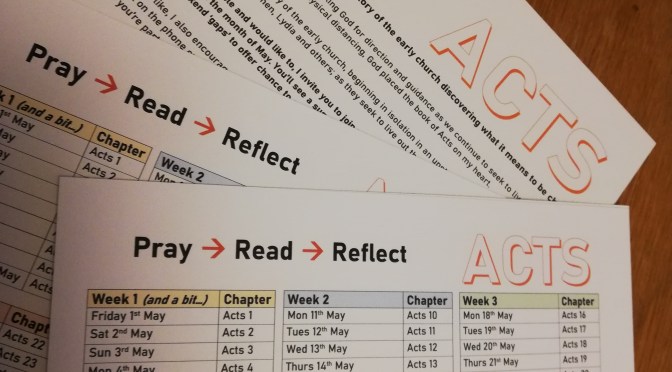
Today some of us begin a journey through the book of Acts. Visit the Worship Resources page and you’ll find the guide and info under prayer and devotion. Anyone is welcome to join!
Studying together, while physically distanced will be new for many of us, but as we continue to navigate these unchartered waters of lockdown, I’ve been minded to ‘just go for it’ and learn along the way. We’ll see where God takes!
As part of the daily rhythm I’ve suggested some pointers for daily reflection:
Some Pointers to help Daily Reflection
What verse stands out to you?
Read it again, chew on the words…
What message might you be hearing today?
What is God saying to you through today’s chapter?
Write it down. Pray about it. Come back to it later.
Where may God be speaking to the church today through the passage?
Make a note of it. Share it with someone else from church.
I won’t post on here every day, but for day 1 I thought I would share briefly my reflections.
What verse stands out? For me, it was 1:7 ‘It is not for you to know the time or period’. A lot of life at the moment feels like waiting, waiting for lockdown to ease, waiting for the next change to come, waiting for an idea of how much longer we’ll be physically distanced from one another. I don’t know the time or period.
What is God saying to me? I feel God saying “Don’t worry about tomorrow, I’ve got you”. Be patient and embrace TODAY – don’t worry about tomorrow for now, by my Spirit I will provide the strength and resource you need for each day. Trust me.
Where may God be speaking to the church today As they wait for the time God has promised will one day come, the believers pray (1:14, 24). In uncertain waiting, it was to the act of prayer that the disciples turned. Perhaps that’s the greatest and power powerful action God’s people can make right now.
Share your reflections
Why not read Acts 1 and reflect for yourself, and share your thoughts in the comments below. How is God speaking to you today?
This week, in a slightly longer than ‘normal (!) vlog, I look at Luke 24 (the Road to Emmaus) and reflect on how our plate and cup are empty, waiting to be filled because as Methodist in Britain we are not practicing communion while we are physically distancing and unable to gather as worshipping community.
The text below the video is roughly the same as what’s in the video, but at the bottom of the blog post there’s an extra video, a downloadable version of the blog post for printing, and of course, opportunity for you to join your thoughts to the conversation!
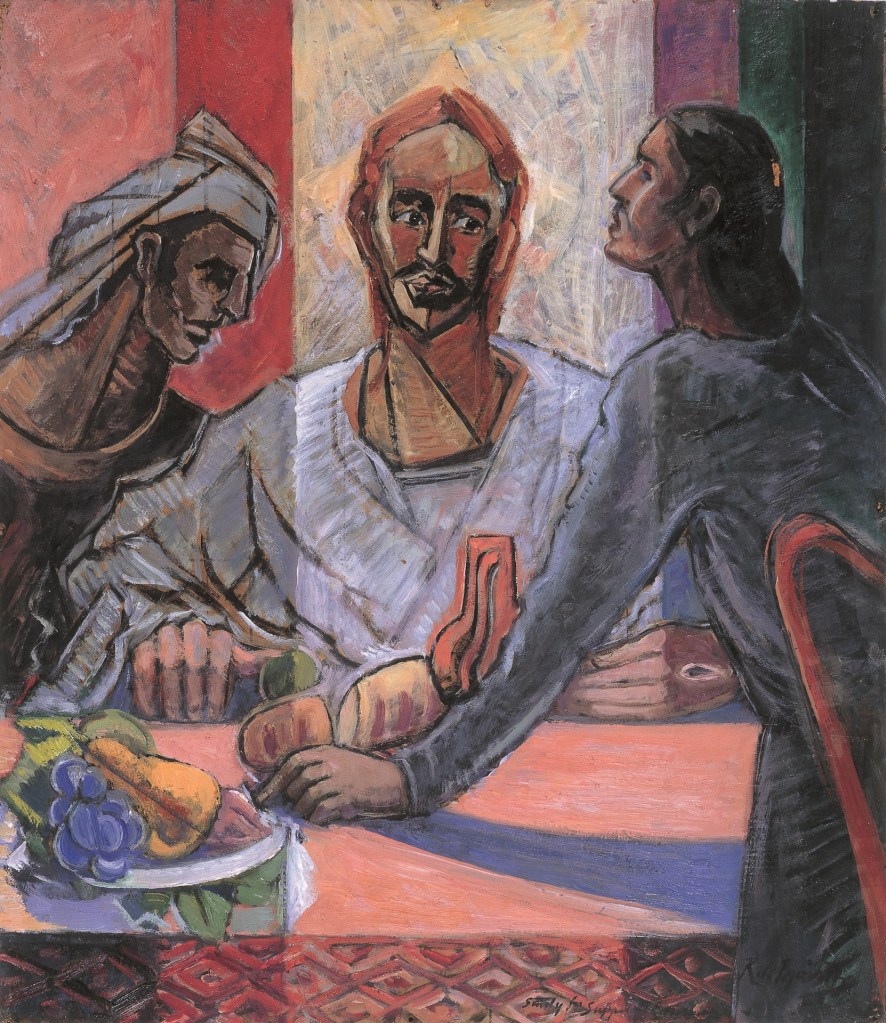
In Luke’s gospel, after Jesus resurrection, we find the story of Cleopas and his travelling companion on the Emmaus road. I shared a reflection on the passage in last week’s Sunday reflections.
Cleopas and his companion are filled with grief and uncertainty after Jesus’ death and then a stranger joins them on their journey. And they hadn’t any clue who this stranger was.
“As they came near the village to which they were going, [the stranger] walked ahead as if he were going on. But they urged him strongly, saying, ‘Stay with us, because it is almost evening and the day is now nearly over.’ So he went in to stay with them.
When he was at the table with them, he took bread, blessed and broke it, and gave it to them. Then their eyes were opened, and they recognized him; and he vanished from their sight.”
Luke 24:28-31
What I have found striking reading this over the last week is that it is in the breaking and sharing of bread that the true identity of Jesus is realised. As they sit together, in fellowship with one another, learning and discerning and questioning, eating and drinking, the bread is broken and Jesus is seen for who he is.
Breaking of bread is one of the many titles in Christian tradition we use for communion, Eucharist, the Lord’s supper. This week the Emmaus story has set me thinking about communion.
This is my home communion set. It was given to me by my placement church while I was training, a multi-cultural congregation in a deprived and diverse suburb of Birmingham. This reminds me of where I’ve come from, and how I’m part of the national and global church.
I use this set to take communion to people who are housebound. So it reminds me both of the local churches which I serve, but also of the homes to which I have visited and shared communion.
This set reminds me that the presence of God is everywhere; global, national, local and in our homes.
Communion is something may be important to our spirituality as individuals and as worshipping communities.[1] It is a meal we share, through which we remember Jesus sharing a meal with his friends before his arrest and crucifixion. We take bread and wine, symbols of the body and blood of Christ, we bless them, break them and share them as we remember Christ and experience him present with us now.[2] Where we are embraced by the unconditional love and unending grace of God, offered through Christ, made present by God’s Spirit.
But for the moment, the plate and cup are empty. We’re not sharing communion together. We are distanced from one another, unable to physically gather and share as a worshipping community.
At the moment, some churches have been practicing communion online, but as British Methodists, we are not. In 2018 our Methodist Conference considered virtual communion, albeit considered under very different circumstances to that which we find ourselves in today. Conference voted against the practice, and while given current circumstances I suspect the conversation and decision might go differently, for now we follow those decisions, leaving plate and cup empty, waiting for the day they can be filled again.
For me, I want to be honest with you, I’ve come to a point where I’m ok with that. It’s painful, not being able to share communion with those I know dearly wish to receive it. It’s painful not the able to gather at the table to share as a worshipping community.
Some of you may share my feeling ok, but I expect that for some of you, not receiving communion has been, or is continuing to be difficult right now. I want you to know I understand something of that struggle. But I also want to share with you a little bit about why, for me, I’ve come to a place where I feel ok for the moment, that the glasses and plate are empty and waiting, as I patiently wait for the time they can be filled again.
And in sharing, I hope that it may help you too.
Filled
At the beginning of this year, many Methodists prayed the covenant prayer, as a sign and renewing of our continuing commitment to living in relationship with God, knowing that God continues to be unconditionally committed to us by his love and grace.
Within the covenant prayer we say the words: ‘let me be full, let me be empty,’[3]
I’ve found reflecting on those words in light of not receiving communion during this time helpful. The covenant prayer contrasts various ways of living, employed or laid aside, having all things or nothing, being full or being empty.
But whether employed or laid aside, having all things or nothing, full or empty, are all included as part of our living in relationship with God. There is never an absence of God.
For me, these words remind me that whether I have received communion or not, all of life is saturated in God, God is still present and part of my life and being. So I’ve felt God helping Me to this time, not as a case of communion being taken away from me, but a time where I consciously abstain, as part of my being emptied for God.
Yet, at the same time, I also see the empty plate and cup being just as presence filled by God’s Spirit as when they are filled with bread and wine.
Inclusion and exclusion
For me, another reason that I feel ok that we leave plate and cup empty is that, if did communion online, what about those who are offline? Who do not have internet access?
before lockdown, when communion was celebrated in our buildings there was inclusive intent within our liturgy and practice, and those that were housebound had the options of home or extended communion.
But today, those who would be excluded from online communion have no other way of receiving.
As part of communion we often share the peace, sometimes preluded by the words:
‘In the one Spirit we were all baptised into one body. Let us therefore keep the unity of Spirit in the bond of peace.’[4]
For me, if I was able to share communion with some of you, I wonder if I would then risk breaking that unity of Spirit and bond of peace, through depriving and excluding some, from what I was offering to others.
To bring us back to Emmaus, in that resurrection story, as Cleopas and his companion offered hospitality to a stranger, it was in the distribution, the breaking and sharing, Jesus was made known.[5]
This Emmaus encounter is not communion as we may have come to practice it. Here is a simple meal and a household who share hospitality with a stranger. In that act of sharing what they had, their guest shares with them everything he is.
We can only gather as households right now, but I can assure you that even though plate and cup are empty, Jesus is present with us, not a stranger but a friend, longing to be a guest at our tables.
It may not be how we’re used to it through communion, we still patiently wait for a time that we can once again physically gather together to worship and break bread together, but even while cup and plate are empty, if we allow our eyes to be opened to it;
God’s Spirit, the very presence of God, continues to bind us together; though distanced, we are united – one in Spirit.
God’s unconditional love and unending grace are overflowing for us as much now as they always have.
And whether we feel full or empty, Christ in his fullness is forever with us.
May the peace of the Risen Christ be with you.
Rev Dan
Peace be with you
A video montage of over 100 people signing Peace be with you, put together by some friends based in Manchester. Look carefully and you may find 1 or 2 familiar little faces!
References
[1] See Share this Feast, Reflecting on Holy Communion, (Methodist Publishing, 2018), p6 [2] See Share this Feast, Reflecting on Holy Communion, (Methodist Publishing, 2018), p4 [3] Part of the Covenant Prayer, Methodist Worship Book, p290 [4] Example of the Introduction to the peace, Methodist Worship Book, p189. [5] I must give some credit to a friend who sowed this seed in their blog post earlier this week – https://dbobstoner.com/jesus-on-a-boriswalk/
Join the conversation
if you’ve got thoughts or something to share after reading and reflecting on my thoughts, you can comment below and share them with us all – I’d love to hear from you.
This week I share with you, not my words, but the prayerful words of a 5 year old girl who wanted to write a prayer yesterday morning. Working together, this is what she produced. #ProudDad
This 5 year old’s heart to say thank you to God made me realise how I have sometimes been distracted by other things that stop me from embracing and noticing all I have to be thankful to God for today.
Rejoice always, pray without ceasing, give thanks in all circumstances; for this is the will of God in Christ Jesus for you.
1 Thessalonians 5:16-18
Join the conversation
What does the prayer of this 5 year old inspire you to be thankful for? Why not share your thanks and prayers in the comment section below.
I’ve got such exciting news to tell you. I feel like I’m about to explode I’m so excited. We were so confused but now things finally make sense.
Let me start at the beginning. You must have all heard about what happened to Jesus in Jerusalem. He was arrested, put on trial and they crucified him. We’d been following him, we and the apostles, and Mary and the other women.
We all thought he was the Messiah, the promised prophet. But now he was dead. We all felt lost, heartbroken. Our hopes and dreams for what Jesus was going to do we’re shattered. We we’re worried what the authorities would do next. Would they come after us?
So Cleopas and I we’re heading back to Emmaus. It’s a long walk and we were talking about what had happened. A man we didn’t recognise came along beside us and we began talking to him. What we couldn’t understand is that he didn’t know what had happened to Jesus in Jerusalem.
So we began to tell him what had happened to Jesus. How he’d been arrested, beaten, humiliated and crucified, and how our friends had gone to the tomb this morning and his body was gone. They said they’d seen a vision of angels who told them Jesus was alive. We didn’t know what to think.
But this man we were talking to started to talk about the scriptures and what the prophets had said about the Messiah. He was talking about the scriptures in a way I’d never heard before. He went right back to Moses and the other prophets and we talk and talk about them.
The rest of the journey went so quick, it was no time at all until we got to Emmaus, so we urged the man to stay with us, it was almost night time anyway.
By talking to him things had started to make sense, though we we’re still struggling to get our heads around it all. So we sat having a meal together, we continued talking and then the stranger took the bread and broke it.
At that moment I don’t know what happened, but suddenly we realised something… this stranger was Jesus. How we didn’t see it before I don’t know! It was as if we had been kept from seeing him until that moment. But now it all makes sense, Jesus is alive! And all that’s happened is what the prophets wrote about. We we’re there with the risen Lord, but before we had chance to say anything to him he disappeared.
We could think of nothing else but telling the others so we raced back to tell our friends in Jerusalem. What a day! We forgot that the authorities could be after us, that fear had gone.
We told them how he’d appeared to us, how he talked to us about the prophets and the scriptures, how he’d broken the bread. That Jesus is alive. The Lord had also appeared to Simon.
And now I can tell you too! Jesus is alive! We’ve met the risen Lord and now we’ve been transformed. What a journey.
We’d lost hope, but now he’s alive and he’s given us hope again! We were lost, we didn’t know where to turn, but Jesus found us.
We were feeling broken, but now Jesus has made us whole. We were blind, but Jesus showed us the scriptures and what the prophets said, and now we can see the truth. When he broke the bread, we could see him.
We’d been fearful of what the authorities would do next, but after meeting the risen Lord those fears were gone.
We’ve had such an experience, we’d had a first-hand experience of Jesus. He really is alive, and he’s filled us with hope.
Reflect
As you hear and read this passage what interests you? Surprises you? Why?
The men on the Emmaus road felt lost, confused. Their hopes and dreams had been shattered. Have you ever been in a similar situation? What helped you?
The men welcomed Jesus, who to them was still a stranger, into their home to eat with them. Fellowship and community was always an important part of Jesus ministry. How important do you think it is for us today? Why?
How might what we learn from this passage help us for living as Christians in the 21st Century? What challenges are there?
Join the conversation
if you’ve got thoughts or something to share after reading and reflecting on my thoughts, you can comment below and share them with us all – I’d love to hear from you.
Have any of you had a surprise recently? A surprise phone call? Or a surprise left on your doorstep?
I had a surprise this week – on Easter Sunday Louise got me my favourite Easter Egg, and not just 1 – a box of 12 of the marvellous things – crème eggs!
We’re in the first week of Easter, and this week I’ve been looking at some of the resurrection stories in John’s gospel. I’ve noticed more then I have done before how Jesus doesn’t appear in the temple – the place of worship, but in houses and homes, to people walking and working.
In the resurrection encounters with Jesus, perhaps it’s fair to say Jesus appears to people in isolation, on daily exercise, or working as keyworkers!
One of those passages is John 20:19-22:
When it was evening on that day, the first day of the week, and the doors of the house where the disciples had met were locked for fear of the Jews, Jesus came and stood among them and said, ‘Peace be with you.’
After he said this, he showed them his hands and his side. Then the disciples rejoiced when they saw the Lord. Jesus said to them again, ‘Peace be with you. As the Father has sent me, so I send you.’
When he had said this, he breathed on them and said to them, ‘Receive the Holy Spirit.
If you’ve ever been with me when I’ve led a home communion service, you’ll know I often use this passage. I find it a helpful passage for home communion because in the surprise that Jesus appears in locked room, we are reminded of the truth that Jesus comes to us where we are, in our houses and homes.
And not only that, but Jesus says receive the Holy Spirit, an ever present comforter and strengthener – the very presence of God. I’ve found that a great comfort and strength this week as I seek to live in the resurrection.
Over the last few weeks I’ve been really encouraged by way Jesus is ministering among us even though we’re physically distance from one another. I’ve found the testimonies and stories I’ve hearing in phone calls, emails, messages and on the blog an inspiration. So please keep sharing your stories of Jesus at work!
Always be ready to notice Jesus at work – because you never know what’s coming next!
Share your Story
So that’s one of the ways God has been in my week – what about you?
Where has God been in your week? How might God be surprising you? What ways are you finding strength and encouragement?
Comment below and share your stories of God with us, in us and among us.
After the sabbath, as the first day of the week was dawning, Mary Magdalene and the other Mary went to see the tomb.
Matthew 28:1, NRSV
As Jesus was crucified Matthew tells us that many women who had been following and providing for Jesus looked on from a distance (Matt 27:55). Two days later, under the dim light of dawn some of them head towards the tomb.
These women were grief stricken, devastated, broken-hearted – having watched the one they’d followed and provided for taken from then, beaten, mocked and killed. And not just killed, but killed under the painful cruelty of crucifixion.
I wonder if those women felt lost, no longer having Jesus to follow and learn from. I wonder if they felt as if they’d lost a sense of purpose, their vocation of providing for Jesus so brutally taken from them. I wonder how they felt now that Jesus was no longer alive. The one who had shown acceptance, compassion and love to these women was gone. I wonder how they felt, with the prospect that they may never be accepted and loved by someone else in that way again.
As they approach the tomb, they expect the stone to be there, sealing Jesus’ body in. They perhaps expect the guards to be there. What they don’t expect, is for the earth to tremble and shake and an angel appear before them, in bright light and dazzling white and roll the stone away – and then take a seat (Matthew 28:2-3).
Matthew’s storytelling makes me smile. All that drama – light, earthquake, stone rolled away – and then what does the angel do? They sit down. Just needs a pot of tea and scones for a truly English picnic (with proper social distancing of course!).
But the angel said to the women, ‘Do not be afraid; I know that you are looking for Jesus who was crucified. He is not here; for he has been raised, as he said. Come, see the place where he lay. Then go quickly and tell his disciples, “He has been raised from the dead, and indeed he is going ahead of you to Galilee; there you will see him.” This is my message for you.’
Matthew 28:5-7, NRSV
In that moment, I wonder what those women felt. Joy or terror? Hope or disbelief? Maybe they did accept the angels invitation and look into the tomb and see it was empty. But did they believe the impossible could have happened? Did they believe this dazzling angel – sat on a stone – was telling the truth?
With both fear and joy they head towards the disciples to tell them. Joy that the angel could be telling the truth. Fear that the angel could indeed not be an angel, in which case what has really happened to Jesus? Was Jesus risen? Was this resurrection thing true?
Suddenly Jesus met them and said, ‘Greetings!’ And they came to him, took hold of his feet, and worshipped him. Then Jesus said to them, ‘Do not be afraid; go and tell my brothers to go to Galilee; there they will see me.’
Matthew 28:9-10, NRSV
The women’s doubts dispelled, they can race on. Joy in their hearts – Jesus really is alive. How? Why? When? None of that matters. They have a message to deliver, there is hope in their hearts – Jesus is alive!
But that’s not the only tale that goes on to be told. The guards, they’ve already headed off to the authorities to report, and another story is soon devised to explain the unexpected events – blame the disciples, say they came in the night and took the body (28:11-13).
And for Matthew’s story (which like Mark, has very little resurrection story to tell compared with Luke and John), even when the other disciples do see Jesus and worship him some still doubt. Could this resurrection thing really be true? And what does it really mean for the future?
When we travel through Lent, and then Holy Week, Easter Sunday is often the end point, the climax, the destination. It’s the place we know we’re going to get to at the end of the pain and suffering. And generally, as soon as dawn breaks – where there.
But for the disciples, for 1st Century Palestine, it’s wasn’t so cut and dried. Resurrection wasn’t such a given. There was doubt, uncertainty and fear. There were multiple stories and little resource to tell the difference between them.
It took time for the resurrection story to spread across society. It took time for the resurrection to be believed. It took time for Jesus friends to experience the resurrection for themselves.
For Jesus’ first followers, and for 1st Century Palestine, the Resurrection was not a one day event. It didn’t arrive for the whole of society as dawn broke, but took time to be known, experienced and believed – if indeed it was believed at all.
We know the truth of the resurrection. We live the truth. Jesus Christ is Risen – He is Risen indeed! Alleluia!
Due to Covid-19, there is an inevitability that for many of us, while knowing the truth, Easter Sunday will feel odd, different & strange. It may be hard to hold onto the truth in the isolated living we currently experience.
I think it’s worth reminding ourselves that rather than a one day even, Easter is a period – a season – which takes us from today all the way to Pentecost (this year 31st May). A season of entering into the new of the resurrection, where the discovery of the hope of new life is allowed time to be fully known, realised and experienced.
Perhaps this year we experience the resurrection more like Jesus’ first followers did, and more like the Easter season invites us, not as the dawning of a one day event, but one that takes time for us to fully realise. One where we embrace the wonderful and life changing truth of the resurrection of Christ, the truth that sets us free, while waiting to discover the full impact of the resurrection to come.
No gathering to worship in church buildings and singing Thine be the glory with organ at full blast. They remain as empty as the tomb. Waiting. For those who are used to it, no Easter Sunday communion – today the plate and cup remain as empty as the tomb. Waiting.
They wait, and we wait, for when our resurrection from lockdown comes.
Waiting to discover afresh resurrection’s impact.
All the while knowing the truth which sets us free.
Jesus Christ is Risen – He is Risen indeed – Alleluia!
Join the conversation
if you’ve got thoughts or something to share after reading and reflecting on my thoughts, you can comment below and share them with us all – I’d love to hear from you.
Some initial thoughts on what Holy Week during the coronavirus pandemic might challenge us to reflect on for the future mission and ministry of God’s people.
Reflecting on my first year of ministry, Maundy Thursday was one of the stand out moments where I made new discoveries about myself, my calling and how I inhabit the role of Presbyter within the Methodist Church and the churches in which I serve.
That year, for the first time in my life I washed feet. Washing the feet of worshippers that day and then sharing the Lord’s Supper together was a time in which, through my own experience and practice, I discovered new insights into what it means to be a minister of word and sacrament, to lead and serve.
Jesus, knowing that the Father had given all things into his hands, and that he had come from God and was going to God, got up from the table, took off his outer robe, and tied a towel around himself. Then he poured water into a basin and began to wash the disciples’ feet and to wipe them with the towel that was tied around him.
John 13:3-5, NRSV
Jesus’ radical act subverts the cultural expectations of the day as he kneels to wash his disciples feet. I noted in my journal at the time how moving and humbling the act of foot washing had been for me. How it had helped me to understand more deeply and feel more fully what I already knew in my head to be true, the importance of servanthood to ministry. Ministry that inhabits an attitude of kindness and compassion, love and humility.
Within the Methodist Ordination service, the President says to ordinands:
“In [God’s] name you are […] to lead God’s people in worship, prayer and service; to minister Christ’s love and compassion; to serve others in whom you serve the Lord himself.”
Methodist Worship Book p302
Looking back on 2 years of ministry, I don’t think there’s been a moment where I have felt both my being and my doing have inhabited that calling as fully and intensely as I felt on my first Maundy Thursday in ministry.
But 2020 is different. It could hardly be more different. As I woke yesterday morning, I was feeling bereft that I would not be washing feet, presiding over the Lord’s Supper, gathering together as God’s people as Jesus did with his disciples the night before his crucifixion.
Holy Week, unsurprisingly feels different this year. In some ways it doesn’t feel like Holy Week – partly for the simple reason that the rituals and habits that are meaning making for me, and contribute towards what Easter normally ‘feels’ like have been removed as we cease gathering for fellowship and worship as a result of the coronavirus pandemic.
A friend and colleague shared similar feelings on Twitter. His asking echoed with my feeling bereft and made me think even more of those feelings on Maundy Thursday 2019, reminding me afresh of what I had experienced and how I had felt last year.
But what was helpful, was that it also stimulated me to look forwards, to what I was about to do, and begin to see that the qualities of ministry I recognised so strongly last Maundy Thursday might still be encountered in new places, under our current new landscape.
Instead of all that had been scheduled in the diary for Maundy Thursday, I spent the morning working with Bognor Foodbank, who are distributing food parcels from the church hall at Bognor Regis Methodist during the pandemic.
What I realised in the course of the day is that those qualities of kindness and compassion, love and humility, were there again in this different opportunity for serve God’s people. New places, same ministry.
They were not in a towel and basin but in carrier bags of staple foods.
They were not in bread and wine but tins of tomatoes and custard.
They were not experienced in gathered people for worship, but in a queue of socially distanced people in need.
They were not found through serving the people of the church itself, but through serving God’s world.
John’s Gospel account of Jesus washing his disciples feet goes on:
For I have set you an example, that you also should do as I have done to you.
Very truly, I tell you, whoever receives one whom I send receives me; and whoever receives me receives him who sent me.’
John 13:15; 20. NRSV
If the act of washing feet last year was a symbol and signpost for me to Jesus the servant-hearted leader, and my being and doing was a signpost to others too, then I’ve come to realise my work with the Foodbank was an act of servant-heartedness itself. With that realisation, I’ve felt encouraged and less bereft, but also challenged as I reflect on that experience and how it may shape future ministry.
Henri Nouwen writes:
“For the minister is called to recognize the sufferings of his [sic] time in his own heart and make that recognition the starting point of his [sic] service.”
The Wounded Healer, Darton Longman and Todd, p.xxii
There is importance for our spirituality in what have been the ‘normal’ rhythms and ritual of worship and ministry. We are creatures of habit and the rhythm feeds our faith, reminding us of that which has gone before us. Building us up, brick by brick, act by act.
Yet, while recognising that, as we turn to the suffering and sacrifice of Good Friday, as we refrain from gathering together at the cross, and all those other things we ‘normally’ do on Good Friday, I’ve felt challenged to ask of myself whether I’ve placed too heavy a meaning into the ritual and the rhythm. For those same qualities I felt so intensely as I washed feet, I also found through serving carrier bags of food to those in need. Is there ‘stuff’ that has become ‘normal’ in my life that needs sacrificing for the sake of serving a suffering world?
Does Jesus look on me and say Father, forgive; for they do not know what they are doing? (Luke 23:34)
As I stand, alone, at the cross today, As I stand distanced from my sisters and brothers, As I stand before my Saviour who suffered and died at the hands of cruelty, As I call to mind how society, political power and religious leaders rejected Jesus, I’m left asking myself what sacrifice might I need to make? As I watch Jesus die, I ask what needs to die to make space for resurrection to new life?
As I wrestle at the cross today, I’m convicted that this wrestling is not only for me, but God’s church as a whole.
How will coronavirus – the isolation, the distance the suffering, the sacrifice – change our experience of Holy Week and Easter? Change the very ways that we are church? What sacrifices will our experience challenge us to make, for the sake of serving a suffering world?
I am convinced these questions are imperative for the future mission and ministry of God’s people. For in standing at the cross, gazing upon our suffering Christ, holding ourselves open to be challenged and changed by the God who loves us, we allow ourselves to enter into the unknown mysteries of Christ’s suffering and sacrifice, and allow ourselves space to journey towards the discovery of what resurrection to new life after lockdown will look like.











 Rev Dan Balsdon's Blog