Tag Archives: Easter

Someone had to do Something

A monologue from the perspective of Judas, prior to the Last Supper.

I say ‘the perspective’, but it might be better to say ‘a perspective’ as this piece probably has a more compassionate and understanding interpretation of Judas than Christian tradition as always portrayed.


The name’s Judas.
Jesus called me – like he did the rest of us.
I’ve listened to his teaching.
Travelled far and wide.
He commissioned me with the rest,
with authority to heal and preach and cast out demons.

And boy does the world need that.
The evil powers of the Romans,
Influencing everything.
They’ve got the pressure on the temple leaders.
Pushing them into a corner.
Corrupting our religion, our way of life. 
Something’s got to change.

And Jesus’ radical message was one I was wholeheartedly behind.
Down with the Romans and their defilement of our country!
I’m ready to take them on by force.
And there’s others too.
There’s plenty of people who want to see them gone.
I’m ready to rally the troops when Jesus gives the signal.

In the meantime,
I’ve been serving the cause as treasurer for Jesus and the group.
Managing the money,
Making sure we have enough to get by.
It’s hard work – life on the road,
Not knowing whether we’ll have a safe place to sleep each night.

Especially when Jesus doesn’t exactly tell us the itinerary for the week.
It’s hard to plan ahead when you don’t know where you’ll be by nightfall!
And then he goes and disappears to ‘be with his father’,
without even telling us where he’s going!
The number of times we’ve not been sure where he is.
Worried they’ve captured him.

And given how increasingly unsafe it’s been getting,
That’s been really concerning me.

And then walking into Jerusalem,
Boy oh boy I thought it was the moment,
Riding a donkey,
And parading in from the east,
just as Pilate was doing so from the west.
The crowds gathered,
“Hosannah to the Son of David!”

I was getting ready to sound the trumpet,
And rally the troops,
I knew we could do it,
Liberate our people,
And get back to being the community of God we’re called to be.

But then, he went and trashed the temple!
We’re meant to be overthrowing the Romans,
Not our own!
I mean, yes the Romans have a lot of control in the temple,
But trashing the temple,
Think about the optics!
That looks like an attack on our people,
Not the Roman puppeteers who exert their power. 

It was at that point,
I decided that the pressure must have been getting to Jesus.
He was risking everything,
The impetus that’s been building among the people,
That I’ve been building among those willing for an uprising.
Now people were beginning to doubt.

So I decided,
I’ve got to do something.
I’d save the programme.
Steady the ship.
Steer us in the right direction.

And Passover is just the time to do it.
Jerusalem is full of people remembering how God delivered Isreal from slavery of Egypt.
Full of people who will be on right side of the fight.
Now God will deliver us from the oppression of the Romans,
Just like he did for Israel when the escaped Egypt.  

So I quietly went to see the Chief Priests.
Asked them what they wanted,
And they said, if I hand him over to them,
Betray him,
They’ll sort the rest. 
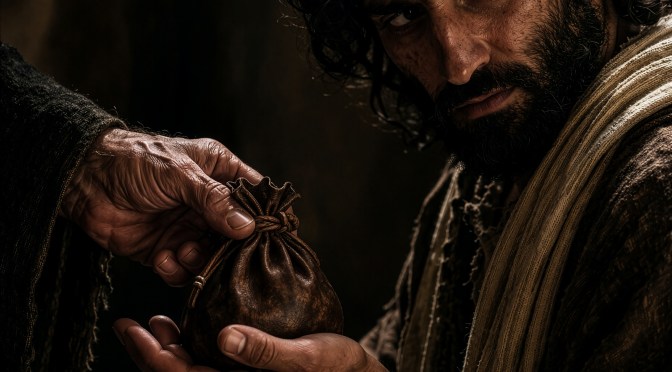
And pay me 30 pieces of silver for it!

Betrayal – that’s a loaded word.
I wasn’t betraying him,
I was just creating the right circumstances for Jesus to do what Jesus came to do.
Revolution.
Reform.
Out with the Roman’s – in with God’s way.
God’s kingdom – come on earth.

So if Jesus is Messiah,
The one who has come to save,
When he gets arrested,
Captured,
They he’ll have no choice,
But to make the call to arms,
And we’ll gathering in great numbers,
Overthrow the Romans,
And we’ll be liberated at last.

And 30 pieces of silver,
That will go a long way to convince the people on the fence about joining us in the uprising.
It’s an added sweetener,
An investment to help the cause.

The Romans will all be taken off guard,
And the revolution will really begin.
It’s not betrayal.
It’s just doing what needs to be done.
Nudging things forwards,
Before the momentum gets lost.

It’s a weight of responsibility.
I feel it heavily.
But it’s the burden I have to bear,
The sacrifice I make,
for the cause of the kingdom of God.
I’ve just got to do something.

Gathering to celebrate

They gathered,
In that upper room,
To celebrate the feast.

A space prepared,
To welcome them,
Together and in peace.

The city
had been stirred,
When Jesus rode in on an ass.

He upturned
Tables in the temple,
And said what would come to pass.

When walking from the temple,
They’d said
‘Look how large and grand’

Yet He’d replied
One day soon,
No stone would be left to stand.

Sun will darken
Moon go dim
Stars disappear from the heavens.

And the powers
and principalities
of all the earth be shaken.

And now he says,
Quite openly,
My time is getting near,

So let us
Celebrate the feast,
It is that time of year.

The disciples
Didn’t understand
All these things he’d said.

They talked together
Pondering
What really lay ahead.

But despite all that,
As was his call,
They’d gathered there as one.

With hopes and fears
Uncertainties,
Unsure what was to come.

So now,
In this borrowed room
They gathered side by side,

To celebrate
The Passover,
With us, God abides.

Unbounded Love, Bound Up

“So the soldiers, their officer, and the Jewish police arrested Jesus and bound him.”

“Then Annas sent him bound to Caiaphas the high priest.”

John 18:14 & 24

Over the season of Lent 2024 I’ve been journeying with the theme ‘Unbounded Love’, a phrase that appears within Charles Wesley’s Hymn ‘Love Divine’, and the title of the 2024 lent resources from The Methodist Church.

So as I began to prepare worship for Holy Week, I have been struck by the way John 18 refers to how Jesus was bound by those who arrested him, leading me to write this meditative reflection.

It could be used on Maundy Thursday or Good Friday, as a tool to reflect on the arrest of Jesus, and the uncertainty this would have left his followers with.

Unbounded Love, Bound Up

They bound him,
After they arrested him,
After the betrayer had kissed him,
After he had told Judas to do what he had to do.
What now?

They bound him.
The one who said come to me and I will give you rest.
The one who said he had come to give us life in all its fulness.
The one who said he would quench our thirst.
What now?

They bound him.
The one who showed compassion to the marginalised.
The one who offered release to those bound by evil.
The one who healed the sick and brought hope to so many.
What now?

Jesus – the one who came and showed us what real love looks like,
Compassionate, caring, nurturing, welcoming,
Love unconditional,
Love unlimited,
Love unbounded,

And his unbounded love angered them.

And so they bound him.
Unbounded love, bound up.
What now?

Keep on believing

Part 1 of a 3-part series reflecting on the ending(s) of John’s Gospel, chapters 20 & 21.

PDF Download

Full Text

Do you ever get stuck knowing how to end a letter or an email? I don’t write letters very often, but send many emails, and often pause as I end wondering what the most appropriate ending might be. ‘Every blessing’, ‘best wishes’, ‘regards’, ‘in Christ’. Since the pandemic began I often use ‘in peace and hope’.

I find it fascinating that 2 of the 4 gospels in the bible sort of have 2 endings. Mark has a shorter and longer ending in chapter 16 – depending on which original texts you look at. Often our bibles make this clear with headings and footnotes.

Headings and footnotes don’t usually appear in the same way in John – but it is also thought to have a first and second ending. When we read it, chapter 20 feels to have a natural end – but then, goes on with chapter 21. Many scholars think (though not all!) that chapter 21 was added to the text of John’s gospel at some stage after the first version of the gospel was created.

Stories

All the gospels – Matthew, Mark, Luke and John are stories of persuasion and intrigue and encouragement. Stories of the life of Jesus, the impact he had on the communities he travelled through, and the lives he touched and transformed.

Each gospel comes from a different perspective and was written for differing communities and audiences. Some repeat stories told in other gospels; others hold stories unique only to them. Few stories occur in all 4.

After telling its version of the story – John’s gospel comes to its first end as we read the last verses of John 20:

“Now Jesus did many other signs in the presence of his disciples, which are not written in this book. But these are written so that you may come to believe that Jesus is the Messiah, the Son of God, and that through believing you may have life in his name.”     

John 20:30-31
Keep on believing

The phrase interpreted here as ‘may come to believe’ can equally be interpreted as may continue believing, or keep on believing.

Some scholars believe this second translation is in fact the one intended by John’s author. They argue that one of the key principles of John’s gospel is that it was written not only to persuade and encourage people to believe, but equally, if not primarily, to encourage and sustain the continuing believing of a persecuted and struggling community, who were not the original witnesses to its story.

The text we now call John’s gospel comes from, probably, around 70AD, 40 or so years on from Jesus’ ministry. The text therefore comes from a point in history where the Jesus-story was being passed on from the original witness to the next generation. This generation, who’s faith up to now had been sustained by the original witnesses, were now themselves the custodians of the story. These custodians needed encouragement to continue believing the story and sharing its life-giving power with others, despite the fact they were not original witnesses.

2000 years on, the story continues to be passed on, so I think we can say they did an ok job.

Promised Presence

Before we get to this first ending of the gospel, we have read another important story –Jesus’ post-resurrection appearance to the disicples.

They are locked in a room together, grieving, fearful, lost. And into that room filled with uncertainty and fear Jesus appears and says, “peace be with you.” and breathes on them saying “Receive the Holy Spirit”.

John’s gospel begins with the word that was with God and was God (1:1) – who comes to dwell among us (1:14). An echo of the story of origin that we find in Genesis 1. Now, as we reach a climax to John’s gospel the word that was made flesh and dwelt among us, now breathes the very presence of God upon us.

This promised presence flows throughout the story that is John’s gospel. In chapter 14 Jesus promises the comforter will come to remind what Jesus has taught them and continue teaching more of the story to the community. (John 14:26)

The story lives on

John’s gospel reminds us that what we read in scripture is not the whole story – that the gospel story lives on through the very presence of God – the Holy Spirit – living among us. There is more the be taught, more to be reminded, more to be said. [hence, perhaps, chapter 21 gets added in!]

If the story lives on among us and within us, that means our stories become part of the gospel story – the good news story – that is the transforming life and love of Jesus among us.

So while here in John we are told here is enough of the story that you can believe and keep on believing, by God’s presence with us and in us we too have our own stories to tell of how our human story and God’s story have entwined. Stories of our experince of our lives transformed by the transforming life of Christ.

These stories we can share remind us and witness to the truth that God’s presence is with us, and they encourage us and others to keep on believing.

So friends, what story are you going to tell today?

Easter Shockwave

Reflections on the shockwave that Jesus’ Resurrection brought to the world and continues to bring to us today.

PDF Download

Happy Easter! We’ve journeyed through Lent, through Holy Week, and now we’re here. We can eat an Easter Egg – if you haven’t already that is and celebrate the story of the resurrection of Jesus.

Have you ever been treated for shock? Perhaps sat with a sugary tea after something that you have witnessed or has happened to you? I remember having to lie down in the woods after breaking my wrist in my teens and going into shock.

Well the story of the Resurrection begins with shock. After a tumultuous week where their leader had been taken from them and crucified, you can perhaps begin to imagine just how emotionally and spiritually vulnerable they were already. Some of the women had journeyed to the tomb that morning and found Jesus body gone, and an angel greeting them.

“Do not be alarmed, you are looking for Jesus of Nazareth, who was crucified. He is not here, he is risen. Go tell the disicples that Jesus goes ahead of you to Galilee and you will see him there.”

(Paraphrase of Mark 16:5-8)

We might think the women would be filled with joy and celebration – Jesus is alive! But we are told, they are seized with amazement and terror – and so ‘they said nothing to anyone, for they were afraid.’ I think they were in shock. Needing some time to let the news sink in.  

Eventually the women do tell the disicples – and the disciples meet the risen Jesus and are filled with joy and wonder!

In very different circumstances, we have had a year that has shocked us and shaken us. But the truth of Easter remains the same. Jesus has risen – and that sends shockwaves around the world until the end of time.

God knew the world was a mess, God could see the mess. And so God sent Jesus, and while some of the reasoning is surrounded in mystery, and quite a lot of debate, somehow, through Jesus’ life, and death and resurrection, the deepest and strongest love that has ever existed is outpoured onto the world, and onto us. Friends – hear me today – share with you this shockwave that comes to the world, and to you – you are loved. You are forgiven. You can find freedom. Yes you.

The Easter shockwave does all that – with hope and with certainty.

But it doesn’t end there. Jesus invites us into a relationship, a partnership, a journey. To be partners in the shockwave of a story that is filled with mystery and wonder. Joy and celebration. Where we are loved, forgiven and free.

And just as we are a diverse human race, that journey looks different for all of us.

Ask anyone who has partnered with Jesus – and they will tell a different story of mystery and wonder and joy. But threaded through them all, is the truth that we are loved, forgiven and free.

Folks, today I invite you into the journey that is the shockwave of Easter.

If you want to know more, and I really hope you do, get in touch with me or your local church to share your story, and discover the threads of love, forgiveness and freedom that Jesus has already woven for you.

Happy Easter!

Playing Power, Playing God

Today is Palm Sunday, the day we remember Jesus’ Triumphant Entry into Jerusalem. You can read the story for yourself in all the gospels, including Luke 19:28-40.

Downloadable PDF

Full Text

This week is Palm Sunday, so named after the palm branches people picked up from the ground or cut from trees to wave and shout with triumph as Jesus’ rode on a donkey and entered the city of Jerusalem.

But this week my mind has been as much on the Christmas story as it has been on the triumphant entry of Jesus into Jerusalem.

Why? Well, last Sunday was Census day here in England and Wales. And as I filled in my census, I was reminded that according to Luke’s gospel it was a census called by Emperor Augustus that led to Mary and Joseph taking a journey from Nazareth in the north, the Bethlehem in the south to register. (Luke 2)

There is no mention of a donkey in Luke’s gospel, but it is perhaps a faux-pas that is helpful for us today – linking these two journeys – Christmas and Palm Sunday – together for us.

You see, I was thinking about how the call for a census, in some way, can be seen as the people in power using that power to play God – by seeking to know who is who. For Joseph and Mary it was the first census, the first time people had been asked to ‘register’. By registering, the ruling powers now knew who was who, and perhaps even where they were – certainly, because the people had to go to their hometown, where they had come from was now known.

Living in 21st Century we’re quite used to other people having details about us. Type “Dan Balsdon” into a Google search and it will soon tell you much about me!

But up to this point in history to be known was not something that would be seen in the same way. You might be known by your local community, a few traders in other places perhaps, family if they lived elsewhere, and for the faithful – by God. The idea of being registered in a society or country was not normative.

The opening line of Psalm 139 hold much more significance when we recognise that to be known had a very different emphasis and meaning before that first census.

“O Lord, you have searched me and known me.” (Psalm 139:1)

And so I wonder, given all of time and space, why God chose this moment, when a census was to be taken that would make the unknown known, that would change the societal and economic map, that would have an impact on the dynamics of power for the future, as the time for the Word to be made flesh and dwell amongst us. (John 1)

30 or so years on, Jesus journeys on a Donkey into the city of Jerusalem. Depending on which gospel account you read there are palms waved (though not in Luke’s account) and cloaks laid on the ground (but not in John’s account). And it is commonly titled something along the lines of Jesus’ Triumphal entry into Jerusalem.

But actually, it’s not the triumphal entry we might expect. The moment is once again a particular one, because as Jesus entered Jerusalem by the east gate, Pilate was entering by the west, in full military procession, with soldiers in armour and sword, probably horses and chariots.

Jesus’ entry is distinctive and different, almost to the point of comedy. Instead of swords there are tree branches. Instead of soldiers in clothed armour, people de-clothed and laid them down on the ground. Instead of horse and chariot, there are disorganised crowds and Jesus rides a donkey.

Jesus is playing with power by subverting expectations – saying ‘I’ll be king, I’ve be a Saviour, but not the king or Saviour anyone will expect – just you watch’.

Jesus had been challenging power in many ways for many months, and it finally comes to a head in Jerusalem, where Jesus is arrested, put on trial and crucified. But while Jesus can be said to be playing with power, he was not playing with God. Jesus was God.

For mere days later – what happens – well, spoiler alert – Jesus’ shows the true power of God – and is raised to life again. Much to the surprise of everyone!

While the sort of society we live in today is a far cry from that of Jesus day, Jesus’ call continues to us, to pick up our palms and challenge misuse of power, to challenge institutions and regimes that play God, and put our one true God who truly knows us for who we are, beautiful and wonderful beings made in God’s image, with capacity to love and do amazing things, at the centre of our very being.

So friends, what palm are you going to pick up and wave today?

My Soul is…

A reflection based on John 12:20-33.

Reflect: how does your experience of ‘feeling’ through the pandemic echo with or conflict with what you believe or know to be true of God?

Downloadable PDF

Full Text

In John 12, after being approached by Andrew, who has been approach by Phillip, who has been approach by Greeks wanting to come to the Passover festival (are you still with me!?), Jesus begins to talk about his coming death. Or at least, we know that he was talking about his coming death. The author of the gospel of John knew. The disciples, the Greeks, the crowd? Perhaps not so much.

In a moment which, in the text, takes us from a conversation with those around him to a conversation with his Father, Jesus says ‘Now my soul is troubled’. (John 12:27)

Though troubled is perhaps an understatement and under-interpretation of the truth of Jesus’ feeling here. A more literal interpretation of the Greek might be agitated, or more crudely, in shock, turmoil or distress.

Jesus wasn’t troubled in a trite and simplistic way. it wasn’t simply that the shopping delivery had arrived and they had swapped your beloved smokey bacon for your less favoured unsmoked.

Jesus was feeling turmoil and anguish in the depths of his soul because of what was looming on the very near horizon. He was soon to be glorified – which to the Author of the gospel, Jesus’ being glorified was the being ‘lifted up’ – the cross.

As Christians we talk of glory, often, as a good thing – ‘To God be the glory, great things he has done!’ goes the popular hymn. But Jesus was not feeling good – despite knowing what was to be gained through this moment.

Jesus has already talked about how useless a single grain is unless it falls into the earth and dies, to then come forth and bear much fruit. (John 12:24)

Jesus seems to know here, what needs to happen – but his feeling – his feeling was pain. His feeling was turmoil. His feeling was fear. His feeling was urging him to say to his Father ‘save me from this hour, this time that I know is at hand’ John 12:27.

In a moment of pain and fear, Jesus was honest with God about how he felt, despite what he knew was to come.

Friends, when was the last time you told God how you feel? How you really feel? Asked ‘where are you God?’ when you’re struggling to feel God with you, despite knowing that God is there?

Jesus’ experience shows us that it is ok to be feeling something that is contrary to what we know, or think we should be feeling. We can’t deny the truth. Can’t suppress the reality of our feeling – if we do, we start to be dishonest with God, and dishonest with ourselves.

Friends, be honest with God today, just as Jesus was, because through being honest with God about how we feel, we are honest with ourselves.

Sunday Reflections: Emmaus

Emmaus.

I’ve got such exciting news to tell you. I feel like I’m about to explode I’m so excited. We were so confused but now things finally make sense.

Let me start at the beginning. You must have all heard about what happened to Jesus in Jerusalem. He was arrested, put on trial and they crucified him. We’d been following him, we and the apostles, and Mary and the other women.

We all thought he was the Messiah, the promised prophet. But now he was dead. We all felt lost, heartbroken. Our hopes and dreams for what Jesus was going to do we’re shattered. We we’re worried what the authorities would do next. Would they come after us?

So Cleopas and I we’re heading back to Emmaus. It’s a long walk and we were talking about what had happened. A man we didn’t recognise came along beside us and we began talking to him. What we couldn’t understand is that he didn’t know what had happened to Jesus in Jerusalem.

So we began to tell him what had happened to Jesus. How he’d been arrested, beaten, humiliated and crucified, and how our friends had gone to the tomb this morning and his body was gone. They said they’d seen a vision of angels who told them Jesus was alive. We didn’t know what to think.

But this man we were talking to started to talk about the scriptures and what the prophets had said about the Messiah. He was talking about the scriptures in a way I’d never heard before. He went right back to Moses and the other prophets and we talk and talk about them.

The rest of the journey went so quick, it was no time at all until we got to Emmaus, so we urged the man to stay with us, it was almost night time anyway.

By talking to him things had started to make sense, though we we’re still struggling to get our heads around it all. So we sat having a meal together, we continued talking and then the stranger took the bread and broke it.

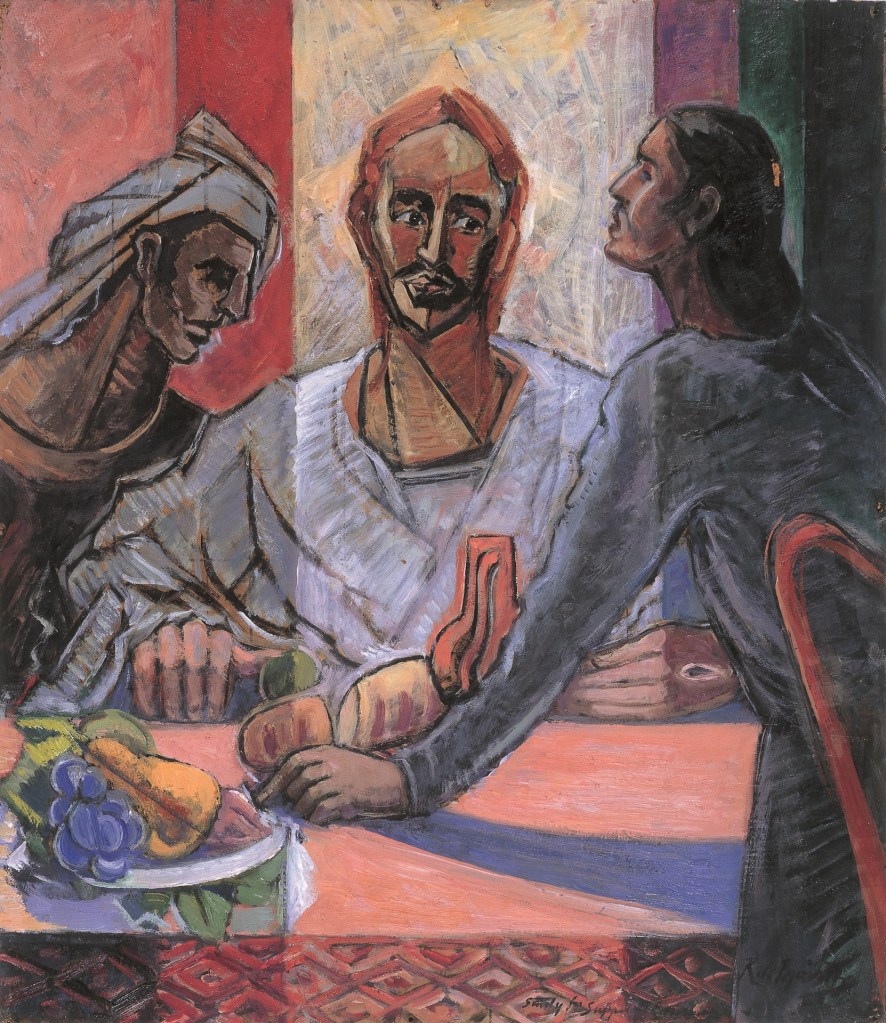
Roy de Maistre – The supper at Emmaus,
from the Methodist Modern Art Collection, © Trustees for Methodist Church Purposes

At that moment I don’t know what happened, but suddenly we realised something… this stranger was Jesus. How we didn’t see it before I don’t know! It was as if we had been kept from seeing him until that moment. But now it all makes sense, Jesus is alive! And all that’s happened is what the prophets wrote about. We we’re there with the risen Lord, but before we had chance to say anything to him he disappeared.

We could think of nothing else but telling the others so we raced back to tell our friends in Jerusalem. What a day! We forgot that the authorities could be after us, that fear had gone.

We told them how he’d appeared to us, how he talked to us about the prophets and the scriptures, how he’d broken the bread. That Jesus is alive. The Lord had also appeared to Simon.

And now I can tell you too! Jesus is alive! We’ve met the risen Lord and now we’ve been transformed. What a journey.

We’d lost hope, but now he’s alive and he’s given us hope again!
We were lost, we didn’t know where to turn, but Jesus found us.

We were feeling broken, but now Jesus has made us whole.
We were blind, but Jesus showed us the scriptures and what the prophets said, and now we can see the truth. When he broke the bread, we could see him.

We’d been fearful of what the authorities would do next, but after meeting the risen Lord those fears were gone.

We’ve had such an experience, we’d had a first-hand experience of Jesus. He really is alive, and he’s filled us with hope.


Reflect

  1. As you hear and read this passage what interests you? Surprises you? Why?
  2. The men on the Emmaus road felt lost, confused. Their hopes and dreams had been shattered. Have you ever been in a similar situation? What helped you?
  3. The men welcomed Jesus, who to them was still a stranger, into their home to eat with them. Fellowship and community was always an important part of Jesus ministry. How important do you think it is for us today? Why?
  4. How might what we learn from this passage help us for living as Christians in the 21st Century? What challenges are there?

Join the conversation

if you’ve got thoughts or something to share after reading and reflecting on my thoughts, you can comment below and share them with us all – I’d love to hear from you.


Download Version


Testimony Thursday: Surprise Encounters

Have any of you had a surprise recently? A surprise phone call? Or a surprise left on your doorstep?

I had a surprise this week – on Easter Sunday Louise got me my favourite Easter Egg, and not just 1 – a box of 12 of the marvellous things – crème eggs!

We’re in the first week of Easter, and this week I’ve been looking at some of the resurrection stories in John’s gospel. I’ve noticed more then I have done before  how Jesus doesn’t appear in the temple – the place of worship, but in houses and homes, to people walking and working.

In the resurrection encounters with Jesus, perhaps it’s fair to say Jesus appears to people in isolation, on daily exercise, or working as keyworkers!

One of those passages is John 20:19-22:

When it was evening on that day, the first day of the week, and the doors of the house where the disciples had met were locked for fear of the Jews, Jesus came and stood among them and said, ‘Peace be with you.’

After he said this, he showed them his hands and his side. Then the disciples rejoiced when they saw the Lord. Jesus said to them again, ‘Peace be with you. As the Father has sent me, so I send you.’

When he had said this, he breathed on them and said to them, ‘Receive the Holy Spirit.

If you’ve ever been with me when I’ve led a home communion service, you’ll know I often use this passage. I find it a helpful passage for home communion  because in the surprise that Jesus appears in locked room, we are reminded of the truth that Jesus comes to us where we are, in our houses and homes.

And not only that, but Jesus says receive the Holy Spirit, an ever present comforter and strengthener – the very presence of God. I’ve found that a great comfort and strength this week as I seek to live in the resurrection.

Over the last few weeks I’ve been really encouraged by way Jesus is ministering among us even though we’re physically distance from one another. I’ve found the testimonies and stories I’ve hearing in phone calls, emails, messages and on the blog an inspiration. So please keep sharing your stories of Jesus at work!

Always be ready to notice Jesus at work – because you never know what’s coming next!

Share your Story

So that’s one of the ways God has been in my week – what about you?

Where has God been in your week?
How might God be surprising you?
What ways are you finding strength and encouragement?

Comment below and share your stories of God with us, in us and among us.

Jesus Christ is risen! – Is he?

Leader: Jesus Christ is Risen!

Response: Is he?

Leader: He is Risen Indeed!

Response: Is he really?

Leader: Alleluia!

Response: I thought he was dead?


After the sabbath, as the first day of the week was dawning, Mary Magdalene and the other Mary went to see the tomb.

Matthew 28:1, NRSV

As Jesus was crucified Matthew tells us that many women who had been following and providing for Jesus looked on from a distance (Matt 27:55). Two days later, under the dim light of dawn some of them head towards the tomb.

These women were grief stricken, devastated, broken-hearted – having watched the one they’d followed and provided for taken from then, beaten, mocked and killed. And not just killed, but killed under the painful cruelty of crucifixion.

I wonder if those women felt lost, no longer having Jesus to follow and learn from. I wonder if they felt as if they’d lost a sense of purpose, their vocation of providing for Jesus so brutally taken from them. I wonder how they felt now that Jesus was no longer alive. The one who had shown acceptance, compassion and love to these women was gone. I wonder how they felt, with the prospect that they may never be accepted and loved by someone else in that way again.

As they approach the tomb, they expect the stone to be there, sealing Jesus’ body in. They perhaps expect the guards to be there. What they don’t expect, is for the earth to tremble and shake and an angel appear before them, in bright light and dazzling white and roll the stone away – and then take a seat (Matthew 28:2-3).

Matthew’s storytelling makes me smile. All that drama – light, earthquake, stone rolled away – and then what does the angel do? They sit down. Just needs a pot of tea and scones for a truly English picnic (with proper social distancing of course!).

But the angel said to the women, ‘Do not be afraid; I know that you are looking for Jesus who was crucified. He is not here; for he has been raised, as he said. Come, see the place where he lay. Then go quickly and tell his disciples, “He has been raised from the dead, and indeed he is going ahead of you to Galilee; there you will see him.” This is my message for you.’

Matthew 28:5-7, NRSV

In that moment, I wonder what those women felt. Joy or terror? Hope or disbelief? Maybe they did accept the angels invitation and look into the tomb and see it was empty. But did they believe the impossible could have happened? Did they believe this dazzling angel – sat on a stone – was telling the truth?

With both fear and joy they head towards the disciples to tell them. Joy that the angel could be telling the truth. Fear that the angel could indeed not be an angel, in which case what has really happened to Jesus? Was Jesus risen? Was this resurrection thing true?

Suddenly Jesus met them and said, ‘Greetings!’ And they came to him, took hold of his feet, and worshipped him. Then Jesus said to them, ‘Do not be afraid; go and tell my brothers to go to Galilee; there they will see me.’

Matthew 28:9-10, NRSV

The women’s doubts dispelled, they can race on. Joy in their hearts – Jesus really is alive. How? Why? When? None of that matters. They have a message to deliver, there is hope in their hearts – Jesus is alive!

But that’s not the only tale that goes on to be told. The guards, they’ve already headed off to the authorities to report, and another story is soon devised to explain the unexpected events – blame the disciples, say they came in the night and took the body (28:11-13).

And for Matthew’s story (which like Mark, has very little resurrection story to tell compared with Luke and John), even when the other disciples do see Jesus and worship him some still doubt. Could this resurrection thing really be true? And what does it really mean for the future?

When we travel through Lent, and then Holy Week, Easter Sunday is often the end point, the climax, the destination. It’s the place we know we’re going to get to at the end of the pain and suffering. And generally, as soon as dawn breaks – where there.

But for the disciples, for 1st Century Palestine, it’s wasn’t so cut and dried. Resurrection wasn’t such a given. There was doubt, uncertainty and fear. There were multiple stories and little resource to tell the difference between them.

It took time for the resurrection story to spread across society.
It took time for the resurrection to be believed.
It took time for Jesus friends to experience the resurrection for themselves.

For Jesus’ first followers, and for 1st Century Palestine, the Resurrection was not a one day event. It didn’t arrive for the whole of society as dawn broke, but took time to be known, experienced and believed – if indeed it was believed at all.

We know the truth of the resurrection. We live the truth. Jesus Christ is Risen – He is Risen indeed! Alleluia!

Due to Covid-19, there is an inevitability that for many of us, while knowing the truth, Easter Sunday will feel odd, different & strange. It may be hard to hold onto the truth in the isolated living we currently experience.

I think it’s worth reminding ourselves that rather than a one day even, Easter is a period – a season – which takes us from today all the way to Pentecost (this year 31st May). A season of entering into the new of the resurrection, where the discovery of the hope of new life is allowed time to be fully known, realised and experienced.

Perhaps this year we experience the resurrection more like Jesus’ first followers did, and more like the Easter season invites us, not as the dawning of a one day event, but one that takes time for us to fully realise. One where we embrace the wonderful and life changing truth of the resurrection of Christ, the truth that sets us free, while waiting to discover the full impact of the resurrection to come.

No gathering to worship in church buildings and singing Thine be the glory with organ at full blast. They remain as empty as the tomb. Waiting. For those who are used to it, no Easter Sunday communion – today the plate and cup remain as empty as the tomb. Waiting.

They wait, and we wait, for when our resurrection from lockdown comes.

Waiting to discover afresh resurrection’s impact.

All the while knowing the truth which sets us free.

Jesus Christ is Risen – He is Risen indeed – Alleluia!

Join the conversation

if you’ve got thoughts or something to share after reading and reflecting on my thoughts, you can comment below and share them with us all – I’d love to hear from you.

Downloadable Version