Use of this service is subject to the terms and conditions printed in size 3 font on the back left wall of the store – next to the white display unit.
Alternatively you can access our Terms and Conditions through our website by finding the link somewhere on our homepage – usually in pretty small grey font, but it depends if you’re viewing our website on computer, tablet of mobile device.
Ok, so it’s not always that hard to find them, but they’re not always easy to make sense of are them. Terms and Conditions are often long, full of legal jargon, and it’s not unusual that I’m still not sure what they really mean after I’ve read them. In fact, I confess I sometimes just tick the box to say I’ve read them and move on.
Terms and Conditions are part of 21st Century life, every social media account, every purchase we make, every contract we sign comes with some sort of conditions. Rules, guidelines, commitments, legal requirements – from the provider, but also from me the receiver.
I’ve heard lots of times people saying things like ‘God doesn’t love me, I’m not good enough’. Every time it fills me with sadness because somehow the world thinks God has a long list of complicated, undecipherable terms and conditions that mean no one can ever live up to them.
But it’s just not true, this misconception.
In the Bible there’s a letter that Paul writes where he talks about this sense of being cut off from God. I’m putting into my own words here – you can look it up for yourself if you want, it’s Colossians 1:21-22.
once you were cut off from God because of your evil deeds, but now you are reconciled because of Jesus, made holy and blameless and no longer cut off.
In the gospel of John we read Jesus saying:
“anyone who comes to me I will never drive away”
John 6:37b
A relationship with God doesn’t need to start with terms and conditions of us being perfect or thinking we’re good enough. There are no legal requirements.
Relationship with God starts with accepting the wonderful, amazing fact that God loves us for who we are and will drive no one away.
If you haven’t already, start a relationship with God today – he’s ready and waiting to hear from you, and accept you with open, loving arms.
A few years ago we were on a motorway journey and pulled in at a service station. We’d been driving for some time so I was sure in need of a coffee – so got into the Starbucks queue.
I placed my order and, as they often do in coffee shops, the guy behind the counter asked my name and proceeded to scribe it onto the cup in bold black sharpie. I got my coffee and went to sit with the family.
About half an hour or so later, Louise wanted a hot chocolate so off I went back to the Starbucks queue. I placed my order, but this time he didn’t ask my name, he said – ‘it’s Dan isn’t it?’
I was amazing, in a busy service station coffee shop, amongst the busyness of his day, I wasn’t just another customer to process through the coffee conveyor – he’d remembered my name – I felt valued for who I was.
When I began leading services, about 14 years ago now! – there was one verse from the Bible that played a massive part in my accepting that this was what God was calling me to.
It comes from Isaiah 43…
“Do not fear for I have redeemed you; I have called you by name, you are mine.”
Isaiah 43:1b
When I began to feel God was asking me to serve him by preaching, I didn’t think I was good enough. I thought I was too young, naive, full of faults and would just fail God.
But God’s words to me were that I was redeemed – that despite my own fears and feelings I wasn’t good enough, God would compensate for them & overcome them.
That those things about me that I thought meant I wouldn’t be good enough, were not a problem at all because God had called me by name. My name, no one else’s, I was the one God was calling.
I believe God is calling you too.
God created you with a unique set of skills, personality and passions – and that unique combination is what makes you you.
God is calling by name, because God wants you to know him, to hear him, to be the person you are and God made you to be.
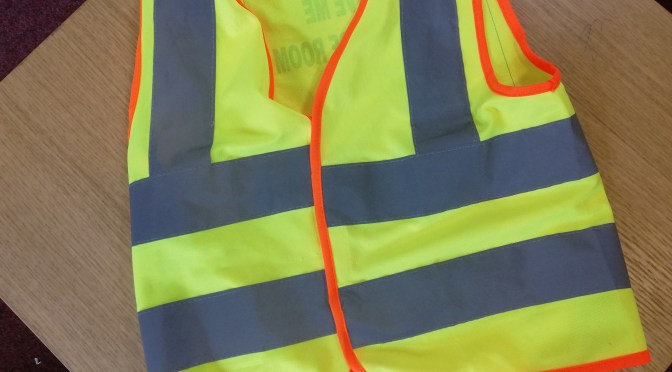
This hi-viz belongs to one of my daughters – a bit small for me! They often wear them when they ride along the pavement on their bikes.
They don’t call it a hi-viz though They know it helps keep them safe and so they have always called it a life jacket.
What do you have that keeps you safe?
Of course we’re familiar with face coverings, keeping distance from one another, we have speed limits and breaks on bikes and cars. We are surrounded by things that are there to keep us safe.
As Christians, sometimes we talk about Jesus saving us. We call Jesus the Saviour of the World. Saviour – literally means someone who saves someone else from danger. Jesus is, in many ways, a life jacket for us, for me, for you, for all the world.
In John 12:46-47 we read Jesus say:
‘I have come as light to the world, so that everyone who believes in me will not be in darkness, I came, not to judge the world, but to save the world’
I have come as light to the world: A bit like a fluorescent jacket, Jesus offers light. Jesus light is not for a limited group people Jesus has written down on a list – Jesus says this light is for all the world – whoever believes will not be in darkness There’s no limit to who can be saved by Jesus’ light – simply believe Jesus is who he says he is – the light of the world, the son of God.
Know the Jesus is not here to judge – but save I would look prettyridiculousif I went out trying to wear this wouldn’t I – I may get a few judgmental looks!
Well we’re reminded here that Jesus doesn’t judge us, and Jesus doesn’t judge you – Jesus doesn’t look at us and criticise us – Jesus came because of God’s love for the world, tosave the world.
And if you’re watching this from the world – then my friend that includes you!
If you want to know more about Jesus do get in touch via social media, email, old fashioned telephone – we would love to talk with you.
Throughout August I will be encouraging us to reflect on things we have learn and are learning through lockdown about self, God and being Christian community.
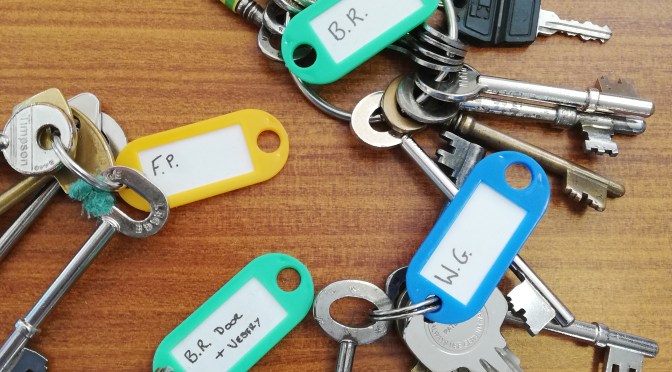
On the 1st September 2016 we moved to Queens Foundation, Birmingham where I was to begin my training. As we’d only got a small, 2nd floor flat for the 4 of us, college had offered us a garage, and, at first, we parked the car in it.
On the 2nd September 2016 we took a trip to the supermarket. We got back, unloaded and I shut the garage door – it was quite stiff to shut, but I kept pushing, thinking, I must get some WD40 for that… until I realised I never locked the car…or shut the boot. I went to re-open the garage door to discover that the boot and garage door were now hitting each other – I couldn’t open the garage door beyond a few inches.
I spent about an hour trying to work out how to solve the puzzle. In that time, I met various other students and members of college staff, their first introduction to me was seeing a stranger trying to break into a garage…thinking back I’m not surprised those conversations started with some suspicious looks.
Eventually, I managed to reach through the top gap of the garage door get some rope tied to the car boot, then reach through the bottom gap and pull it down to get the garage door open. The car boot had a few scratches, but at least I’d got access.
Default ‘church’
Before lockdown, my experience of church communities is that our default way of people accessing ‘church’ was by attending a church building. Within these buildings we hold services of worship, community drop-in’s and coffee mornings, prayer groups and bible studies, toddler groups and quiz nights.
As lockdown came in access to all these things was stopped. Our buildings we’re locked as part of the nationwide effort to reduce physical gathering and push down the spread of COVID-19.
So during lockdown, our default way of accessing ‘church’ – by gathering in a church building – was suddenly blocked from us – just like my car was when I foolishly shut the garage door.
This led to two things – firstly – creativity. Utilising post, email, phone, blog posts, YouTube, video and telephone conferencing and more. Creatively developing lots of different ways for people to engage with church without the building. – to be a scattered church
Secondly – it led to greater self-responsibility. What do I mean?
Well I mean that because accessing ‘church’ has not been about gathering in a building, individuals have had much more responsibility themselves as scattered church for nurturing their faith and relationship with God. The format moved from what could perhaps slightly crassly be described a passive attendance to active engagement. People had their own space and freedom to choose how to engage, how to be church.
Not only that, but people who for one reason or other were much more cut off from the worshiping community, for example living in care homes, working on Sundays or caring for relatives, feel they are included and connected to the worshiping and spiritual life of the church community in ways they never did before.
Matthew 19:13-15
In the gospels we read the familiar story of people bringing children to Jesus for him to bless them. The disciples try to stop it – children, it seemed didn’t matter. But Jesus rebukes them and says let them come to me – the kingdom of God belongs to them too.
It is a passage that’s often used within infant baptism, that vulnerable, innocent children are welcomed by Jesus.
But I wonder, if we take a step back from the story itself, and see it in light of Jesus wider ministry, healing the blind and crippled, spending time with tax collectors and zealots, the excluded and the vulnerable, this passage may take on even more meaning for us.
I wonder if this passage might challenge us as worshipping communities to reflect ourselves on where we might, intentionally, or un-intentionally, be excluding people from being a greater part of the community.
Developing an attitude of access
Lockdown has forced me to look differently at our church communities and makes me wonder if we may have fallen into the trap of letting buildings become too central to our common life together. It makes me wonder how passive we’ve allowed that life to become – and how it unhelpfully and unfairly excludes those who for one reason or other, cannot access it.
But it’s also show me that there are simple ways to begin to redress that balance and build a more accessible and inclusive community. That there are ways access can be achieved for those who are excluded – in part by having a little less focus on buildings, and a little more on discerning how best to connect with people where they are, not where they are not, with our focus on the kingdom of God.
And it’s also shown me the fruit that is borne when individuals have more active self-responsibility for their worshiping and spiritual life.
What may all this mean for the future?
I sense a strong challenge from God – challenging us to not build up ours walls in a way that they keep people out, but to build up one another in a way that allows us to bring people in.
What walls may we need to allow God to break down so that we can grow into a more inclusive and active community that keeps the kingdom of God at the centre?
Throughout August I will be encouraging us to reflect on things we have learn and are learning through lockdown about self, God and being Christian community.
Who are you connected to?
At the start of lockdown, I spent a lot of time on the phone.
Many people in my churches have been shielding, or choosing to isolate, and lots are not on the internet, and so from the start I could see regular phone calls were going to be incredibly valuable during lockdown.
We reorganised the church pastoral system to ensure everyone would have at least 1 assigned regular contact and encouraged everyone to regularly call each other to share fellowship, friendship and maintain relationship.
The hands down thing that has I call people now, people say they have valued most is the phone calls they have been receiving from each other.
People have shared that lockdown has offered the opportunity to get know each other better.
People who live on their own have shared how the phone calls have helped break up their day and left them feeling less alone, that they feel valued, loved, thought about.
That it has not only helped maintain relationships, but that they have grown and deepened.
What has this meant I have learnt?
I think it has shown me just how essential relationships are for human well-being. We need one another. God has created us to be in relationship with one another. Human interaction is in our DNA.
But why has it taken lockdown to get to know each other better?
In Luke’s gospel we find a story of Jesus and his companions, visiting sisters Mary and Martha.
Mary sits as Jesus feet listening to all he has to say. Martha is busy doing – organising the hospitality necessary for Jesus and his companions, fretting that Mary is not helping her.
She stops, and says to Jesus – don’t you care that my sister is leaving me to do all the work on my own?
Jesus says to her, Martha my child, you are so distracted by many things, but there is only need for one thing.
Jesus doesn’t criticise Martha for wanting to be hospitable.
But he does suggest that Martha may be letting the doing get in the way of what really matters.
(To read the story in full, take a look at Luke chapter 10)
I wonder if the absence of meetings and events has meant that the distraction of doing has been removed, and suddenly we’ve discovered new ways of being with one another. Where we can be interested in one another without the distraction of the next task that needs doing or event that needs planning.
And I’ve heard testimony to the same with people’s relationships with God.
Not being busy doing has meant people have been able to spend more time focused on the one thing that matters – their relationship with God.
Now what might this mean we learn from lockdown?
The value and importance of relationship – with God and with one another.
What does that mean for the future as we begin to emerge from lockdown?
I’m not suggesting we shouldn’t have face-to-face activities and events.
But I do find God’s Spirit challenging me to reflect on what may need to change, what we may need to do differently, to keep relationship with God and one another as the one thing that matters.
What ways of being together can we discoverthat do not tie us up in so much doing that we can’t be?
Throughout August I will be encouraging us to reflect on things we have learn and are learning through lockdown about self, God and being Christian community.
In John’s gospel we find a story of a woman who Jesus encounters at a well. It’s the heat of the day, the disciples have gone to get food and Jesus is leaning against the well when a Samaritan woman comes to draw water.
They talk, and the Woman is confused about what Jesus is saying. Jesus talks about the living water he has to offer. She doesn’t understand.
Jesus says to her you worship what you do not know – we worship what we do know. The hour is coming when true worshippers will worship the Father in spirit and truth, for the Father seeks such as these to worship him. (John 4)
Lockdown has taught me that worship is bigger than I understand, or imagine, or ever intended.
Before lockdown, worship tended to be something I went to and often led.
As I prepared and led my hope was always that the offering was a tapestry of music and song and words and prayer and conversation and reflection and gathering and fellowship and participation – with the hope and prayer that God’s Spirit was moving as the thread that weaves it all together into a beautiful tapestry that gives God glory.
A beautiful image, but when lockdown hit, worship was no longer something I could go to. Fellowship and gathering changed. Many of my congregations are not on the internet so it wasn’t feasible or inclusive in the beginning to even think about zoom and streaming.
Worship had to change for us. But worship also had to change for me…. or maybe it was me that needed to change.
Suddenly worship was not something I could ‘go to’. Worship now was not an event to attend, but a practice to inhabit wherever I am. A way of life.
I think those words of Jesus to the Samaritan woman are words that can encourage us today as we seek to learn from lockdown.
We don’t see here Jesus saying – true worshippers will worship in a building for an hour on a Sunday.
We hear Jesus say true worshippers will worship the Father in spirit and truth – true worshippers will not let rules and restrictions (of which there were a fair few back in Jesus day) get in the way of the spirit of worship, not get in the way of the truth of the God we live to glorify and praise.
The effect of lockdown, and the absence of things to ‘go to’ and worship to formally lead has enabled me to begin to embrace the practice of worship in the day to day, every day.
And I know I’m not alone.
There are things people miss – I long for the day we can belt out in song from the depths of our souls – but even as we look to facilitate face-to-face gathered worship in the coming weeks, that won’t happen for now.
But despite the things people miss, through time at home, in our gardens or walking in towns and hillsides people have found opportunities to worship with what they have, where they are, resources we’ve shared, and in doing so been meeting with God – who is with us and receives our worship no matter where we are.
People have been singing to CD’s, radio and TV, gathered online, or via phone conferencing. It may not be a physical face-to-face gathering, but whether alone or in number, these undoubtedly are gatherings of God’s people living a life of worship, where the Spirit weaves our offering into a tapestry that gives God glory.
Lockdown has taught me that worship is bigger, better, stronger, than I had ever truly imagined.
I wonder, as we learn from lockdown, how this might challenge us in how we worship in spirit and truth in the future?
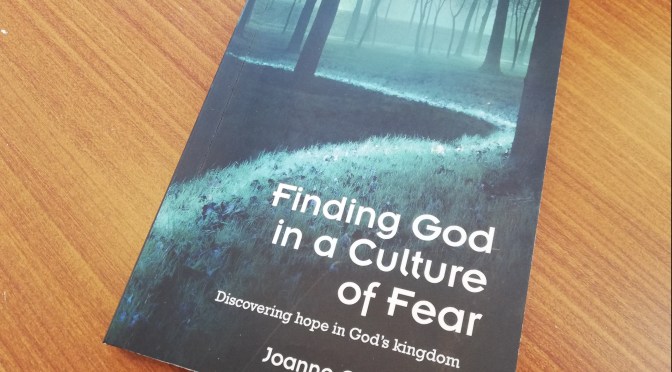
Where do we pin our hope in an age of fear? Fear can be both rational and irrational, it can make our world smaller and less hopeful. Fear can be a place where it is harder to dream big for the future, and can be harder to know where God is in the middle of it all.
And in the midst of global pandemic, fear is undoubtedly a part of human living for many of us at the moment. But what do we do with it? How do we fit the fear we feel within our Christian faith that speaks of freedom, healing, and transformation?
This is a book for anyone living with the realisation that the life is a little broken. For anyone wanting to resist the temptation to retreat into our armchairs and ignore the world.
This is a book that resists the culture of fear that can be seen to be growing in society, and growing among Christian communities.
This is a book that encourages us to discover and rediscover the mystery of hope, which will bring us face to face with the nature of God, character of Jesus and playfulness of the Holy Spirit.
Using the biblical story of the exile, Cox-Darling brings a prophetic voice for Christians to hear. During the exile, the absence of a place of worship was destabilising to sense of community. Yet the story of the exile can was a catalyst to God’s people discovering the true identity of God.
Through rich threads of biblical exploration. Joanne Cox-Darling is convinced hope can be a present reality for us, not just a distant future. That we can find hope in the Christian story, that the church is a window to a community of hope-filled rebels striving to seek first the kingdom of God.
Within these pages, be encouraged to look again at the Christian story as a place to discover a hope-filled resistance, reminded that at the heart of the gospel is the truth that death and despair are never the end.
Discover hope as a catalyst that believes the world can be different, that our living life can be different. That hope thrives in a community of broken people willing to live in brokenness.
Find a call to faithfully and hopefully respond to God who knows our struggle, can meet us in unknown places and offers us stability and constancy, and the hope that things can be better and brighter. God who is the source of all hope, who begins to restore the brokenness, makes a difference to our living, and help us glimpse the light of the kingdom of God.
Throughout August I will be encouraging us to reflect on things we have learn and are learning through lockdown about self, God and being Christian community.
Learning From Lockdown #1 – Diversity & Difference
These giraffes sit on my office windowsill, you might have seen them in previous videos. We bought them on a holiday in France in 2012 and they remind me of our holiday.
They sat on our mantel-piece in Cornwall, then went into storage while we were in Birmingham. When moved here Louise my wife thought we should get rid of them, I didn’t, so we found a compromise and they ended up in my office.
Now they not only remind me of our holiday, they also remind me that as human beings, include married couples, have differences of opinion.
Lockdown as a time to learn
I want to encourage us to reflect this month on what we may learn from lockdown, because I do not believe this is a time of life on pause that doesn’t matter. I don’t believe this is a time that God wants us to waste.
Just as the time the Israelites spent in the wilderness was formational for them, I believe our living in lockdown is a time that can be formational to us. Where God has and continues to speak to us, challenge us and change us.
For some of us, we may feel like lockdown is over, for others, we may still very much feel like we’re in lockdown, for others again, maybe we’re in the middle.
Wherever we stand on that spectrum, it doesn’t really matter, it just goes to prove one of the things that I’ve been increasingly conscious of over the last few months – just how diverse and different we all are.
Diversity & Difference
And that’s where this month of learning from lockdown reflections is going to begin.
In the book of 1 Corinthians we read:
For just as the body is one and has many members, and all the members of the body, though many, are one body, so it is with Christ.
1 Corinthians 12:12, NRSV
The body of Christ, the community of faith, is made of lots of different parts, we all look different, we think differently, respond to circumstances in life with the full colour pallet of human diversity.
I’ve seen the diversity and difference in so many ways through lockdown. Some people have seemed to thrive during lockdown, Energised by the new opportunties and environments and challenges others have really struggled, and others somewhere in between – with good days and some not so good days.
Christian faith is not about conformity – not about creating robots that think and speak the same. It’s about being a community of faith that can call itself a communtiy while celebrating the fact we’re different.
It’s about being people tuned into God’s Spirit, collectively discerning what Gods Spirit is saying to us as individuals and as a community of faith
As we’ve worshiped from our homes, I’ve found my role as minister being less of a leader of worship, and more of an enabler of worship – offering lots of different resources by post and online, seeking to resource the diverse people that make up the churches I serve. It’s been a joy to see diversity thriving, but a challenge at times to keep up!
So as I encourage us to reflect this month on what we may be learning from lockdown, I want to start from a recognition of the diversity and difference among us.
And I want to encourage you all, to think and pray and reflect for yourself… what would you say you’re learning, or have learnt during lockdown.
And try to be go a bit deeper and further than saying I’ve learnt to use zoom.As much of an achievement that may be! `
Where has God spoken to you, challenged you or encouraged you?
What is God’s Spirit saying?
Join the Conversation
Comment below with your own reflections on leanring from lockdown.
For this week’s reflections I talk about how Flying Ant Day as a signpost to God as creator of all that is – creation’s symphony .
Our garden was transformed for an hour or so this week.
Across Bognor, Felpham and Yapton, any maybe other places too, it was ‘Flying Ant Day’.
I saw one post commenting it was good that at least one thing planned for 2020 had actually gone ahead!
As you can see, our garden and patio were crawling with Ants. Every corner of the garden seemed to be covered!
It wasn’t long before social media was populated with posts from across the area commenting on the ants swarming, and according to one post, the swarms were even picked up by satellites.
But why does this phenomenon happen? How do thousands of ants, in separate nests and colonies across a geographical area all decide to fly at the same time?
There’s probably a scientific answer, to do with the inbuilt nature and DNA of an ant which means they all fly when certain atmospheric conditions are met.
Or something like that. I don’t know the science, maybe you do and it would be great to hear, do comment below!
But even if the science does give an explanation of how this phenomenon happens, Does it really tell us why? Where does the science come from? Why does the science mean it happens in this way?
For me, science is a great to way to understand how things happen and work. But for the why – science isn’t where I look. I look to God. Who I believe is the source of life and breathe, Is the reason we live and move and have our being. And through God being the source of all life, all creation is connected to God.
Colossians 1 speaks about the connectedness of creation, and Eugene Peterson puts it this way:
We look at this Son and see the God who cannot be seen. We look at this Son and see God’s original purpose in everything created. For everything, absolutely everything, above and below, visible and invisible, rank after rank after rank of angels—everything got started in him and finds its purpose in him. He was there before any of it came into existence and holds it all together right up to this moment.
Colossians 1:15-17, The Message
So whether it be ants on flying at day, The beauty of a flower blooming, The crispy taste of a fresh apple, the wonder of new birth… Know that by the nature of our being, We are connected to the source of all life, The creator, God.
And through that connection to the creator, all creation is connected to one another, We are part of God’s amazing symphony, Creations’ Symphony Which comes together to sing to the awesome, amazing, mind-blowing and intricate design of creation, reminding us that God is creator, that God is the why of all that is, and leaves us “lost in wonder, love and praise”.[1]
Did you see Flying Ant Day? Do you know the science behind how the phenomenon happens? What reminds you of the creator? Do you even believe God is creator?
Comment below and join the conversation!
[1] Line from Love Divine, Charles Wesley, Singing the Faith No.503
I should have used my torch Or followed someone else, Or slowed down. Then I might have seen the ditch.
But I thought I knew best, My 15 year old self. Thought I would be ok.
Instead, I came away covered head to toe in mud, And one A&E trip later my broken wrist was in bright blue cast.
Grappling in the dark, I thought I was ok. Thought I could find the way on my own.
My pride, my foolishness, and subsequent fall and resulting pain, taught me that sometimes to find my way I need help. From other people, who can hold my hand in dark woodland. From other resources, like a torch to see pits and potholes before I fall.
In John’s gospel we read these words of Jesus.
“I am the light of the world. Whoever follows me will never walk in darkness but will have the light of life”.
John 8:12
Look to Jesus. The ultimate light. Be wise enough to keep close to Jesus, who will guide us, challenge us and change us by his unwavering love for us
Jesus helps us navigate the ditches and woodlands of life. No matter how dark things may feel, with Jesus the light will never fade.
Is there an episode from your life that taught you something about Jesus? Please share in the comments below, stories shared are often a great source of encouragement to others as we pursue faith together.







 Rev Dan Balsdon's Blog