Tag Archives: faith

Home? There is room for refugees

When I was at Theological College I remember a visiting speaker asking us to share with the group where our home was. I naturally responded saying it was here at Queens – because for that 2 year period Queens was home…

But immediately I was asked – “no I mean where is your actual home…”, and I pushed back… “this is my actual home…”

Having moved around a lot as a child, and now training for itinerant ministry – despite the instability it offers, I’ve got quite used to home being a movable place – that where my family is is home.

The Nativity story is also one of changing home. Mary and Joseph leave their home town of Nazareth, and find a borrowed room in Bethlehem – and then they have tio move on again – and end up in Egypt.

An angel of the Lord appeared to Joseph in a dream. 
“Get up,” he said,
“take the child and his mother and escape to Egypt.
Stay there until I tell you,
for Herod is going to search for the child to kill him.”

Matthew 2:13

I wonder how Mary & Joseph felt at that time. They’d got earthly responsbility for God’s son – indeed to them Jesus was their son – and yet so much danger surrounds them.

This year I’ve come to question the line in Once in Royal David’s City ‘And through all His wondrous childhood’ (verse 3). Was Jesus childhood years, living as a refugee, an alien in a foreign land, wonderous? Is it wonderous to live in fear? To have to flee for your life?

Jesus experienced persecution from those who clung desperately to power from an early age. And so too, today, there are people in our world who spread hate against others – including for refugees – simply so that they can cling to their power.

May 2023 be a year when we turn hate into love and hostility into peace – and make room for refugees who from terror and devastation flee.

There is Room for all ages and genders

I was leading a school assembly last week. It’s the first time I’ve visited the school and I was excited to have been invited to lead a Christmas themed assembly for Key Stage 2 (age 7-11). Thought slightly less excited to get a call the night before to say that Ofstead would be around!)

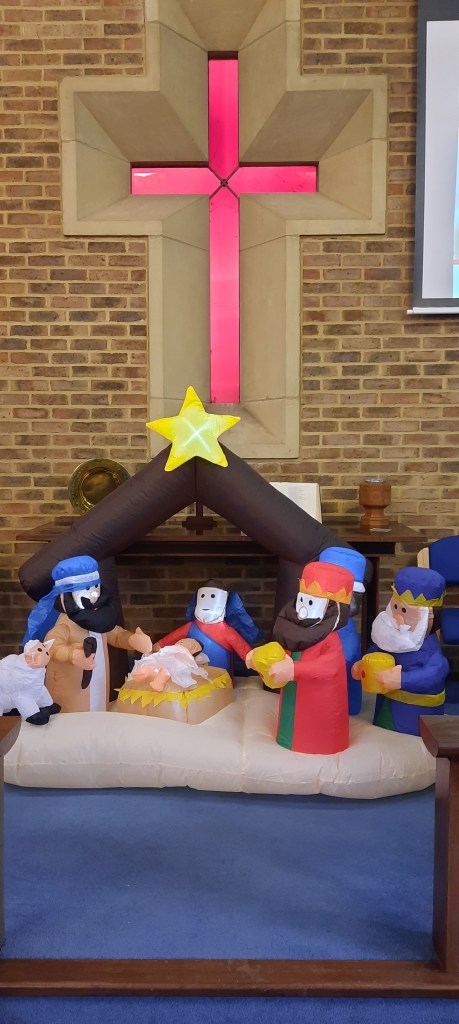
We retold the Christmas story, with some help from a few of our many nativity sets, including my new inflatable one pictured below!

As we began the story in Nazareth with Mary, I was struck that some of those in the room were age 11, and therefore probably not far off the age Mary may well have been when the angel appeared to her – probably in what we’d now call her early teens. 

I then think of my eldest daughter, aged 8, and a friends daughter now aged 12, and can’t imagine the idea of them having children yet! To us today, in our 21st Century, Western society, the Christmas story is indeed one of unexpected turns and subversive moves of God. 

But yet – despite Mary’s youth, God trust her and gives her the crucial task of both bearing the child – and nurturing them after they were born. it is part of the subversive nature of the Christmas story that by coming as a vulnerable babe, God must call on a woman – not a man – to bring the Son of God to birth. We do ourselves a disservice if we neglect to remember that despite the fact scripture talks about a lot of men – there are also stories in scripture of God calling and working through non-men too! mary, Ruth, Rahab, Deborah, Rebekah, Lydia, Susanna, Esther…   

The Advent & Christmas story is filled with stories of God working in and through people that others would overlook, despite gender, age, race, ethnicity… yet in human society we are somewhat obsessed with these labels and categories… always needing to put people into binary boxes, male or Female, Brexiter or Remainer, Black or White…

But the just as God moves against the tide of human society in calling a young woman to bear the Christ-child – so too I believe God does not see the labels and categories we create. God sees people as people, made in God’s image – all loved and valued.

Let us not overlook others because of who they are or how they identify, and let us not be governed by humanly created labels and categories – because in God’s story, there is room for all. 

The Flourishing of Creation: There is Room for all of Nature

If you’re a Great British Bake Off fan, you might remember 2018 series winner Rahul. Rahul left a mark on me, not so much because of his amazing baking, but for who and how he was.

After judging, the programme shows little video clips of the bakers reflecting on their successes – or failures, and the comments from the judges.

Rahul, on numerous occasions would be in mid flow talking to camera and then suddenly divert his eyes another way and say ‘Oh look at those beautiful peonies’, or ‘ooo look at that cute puppy’.

At the time I was struck by the way he noticed & was distracted by the beauty of creation. But I was also equally struck by the fact he kept apologising for it. He apologised for noticing the beauty of nature.

nature is part pf creation – part of God’s world – and so we should notice and marvel at its beauty. And we shouldn’t apologise for that! Scripture is plastered with such awe and wonder – and so should we be. For when creation flourishes – so too will humanity flourish.

Take Isaiah 35 for example:

The desert and the parched land will be glad;
    the wilderness will rejoice and blossom.
Like the crocus, it will burst into bloom;

Then will the eyes of the blind be opened
    and the ears of the deaf unstopped.
Then will the lame leap like a deer,
    and the mute tongue shout for joy.

They will enter Zion with singing;
    everlasting joy will crown their heads.
Gladness and joy will overtake them,
    and sorrow and sighing will flee away.

Isaiah 35:1-2; 5-6; 10.

Isaiah prophecies that creation will flourish with new growth, and as creation flourishes, so too will humanity – for the all creation together will be overflowing with joy.

It might feel a bit strange to be thinking about creation in the midst of Advent – isn’t advent about Jesus – celebrating his first coming to earth…and anticipating his return?

Well yes – but I say, why did Jesus come?

John 3:16-17, perhaps the most well known New Testament verse says:

6 For God so loved the world that he gave his one and only Son, that whoever believes in him shall not perish but have eternal life. 17 For God did not send his Son into the world to condemn the world, but to save the world through him

John 3:16-17

Notice that, while humanity is given particular mention – it is to the world that Christ comes, to save the world.

I hate to burst our human-centric bubble… but the world is not humanity alone. Humanity is not the centre of the universe., and that’s a truth that has been passed down for centuries… at the end of Jonah 4 we find God say to Jonah:

And should I not have concern for the great city of Nineveh, in which there are more than a hundred and twenty thousand people who cannot tell their right hand from their left—and also many animals?”

Jonah 4:11

In God’s heart – there is room for those like us.
There is room for those not like us.
There is room for those who, like the Ninevites, were unaware of the truth of who God was…
There is Room in God’s heart for all creation.

Christ’s salvation work is not just for humanity – but for all of nature. Such is Christ’s heart and love for all life.

Christ comes to the world, to make a way and room for all.
All humanity, and all creation,
To have hope, to grow and to flourish.

And calls us into partnership with him to share the good news,
To invite people to experience the salvation of God,
To care for creation,
To live and love in hope – throughout the world.

To make room for all the world to know God’s love, hope and salvation. Because when God reigns – there is room for all of nature.

Prepare the way – There is Room for difference

In my first year of secondary school, there was a woodland behind the school, and in the woodland lived ‘Knocker’. Knocker got the nickname because, as the story goes, he hid in the woods and knocked on the trees to scare people away.

He was different, lived differently, and was shunned, gossiped about and avoided. but looking back, I have no idea what sort of person he actually was. All I knew about him was based on the bias I’d unconsciously built up through stories others had told, regardless of what the truth actually is.

John the Baptist is one who may well have stimulated similar reactions.


John’s clothes were made of camel’s hair, and he had a leather belt around his waist. His food was locusts and wild honey. 

Matthew 3:4

The point Matthew is making is that John the Baptist was different. In his lifestyle. In his appearance. And in his message.

“Repent, for the kingdom of heaven has come near.” 
This is he who was spoken of through the prophet Isaiah:
“A voice of one calling in the wilderness,
‘Prepare the way for the Lord,
    make straight paths for him.’”

Matt 3:2-3

For 400 years – the period between the Old and New testaments, there had been a perceived silence from God. No prophets, no message. Then from the wilderness comes – the literal wilderness John lived in, and the metaphorical wilderness of this silence, comes a voice saying:


“Prepare the Way!
The Promised One is coming.
Something is about to happen. To change. To transform.
Are you ready?


John the Baptist, in his difference and diversity, is a trailer for the God who is about to do something different. Radical. Revolutionary. To come and dwell with us, as Immanuel, a baby who changes everything.

In doing something different God doesn’t thrown the past out with the bathwater, but takes the story into a new chapter, where prophecy is fulfilled, when the promises of God are made known differently, where the message of love and grace is repacked and transformed – into a living, walking, breathing human being.

In Christ, God did something different.
And still today, God is at work, moving among us many ways.
Known and unknown.
Expected and unexpected.
Making Room for diversity and difference.
Because in God’s story,
When God reigns,
There is room – for difference.

God makes room for you. For me. For us. for all.
Those like us,
Those different to us.

Those like John the Baptist. Those like ‘knocker’ who are different to us, seem strange, unpredictable or unusual.

So In our story,
Will we let God reign?
Will we prepare the way to make room for the difference of God?
The difference of one another?
The transformation that comes from embracing the radical and unexpected of God and God’s kingdom.
Will we make room for difference?


“All This for You”: There is Room for You and Me

As we begin the journey of Advent, the churches I serve are following the theme ‘There is Room’, and in week 1, thinking about how, when God reigns, There is Room for You and Me.

Last Saturday, I had an experience while leading a baptism service that took the truth about how There is Room in God’s story for all to a whole new level.

I’ve done numerous Baptism in the last few years, but always for toddlers. So last Saturday was the first time I baptised a baby.

The baby I was baptising was about 6-7 months old, and as I held this helpless, dependant, innocent child in my arms, looking at his peace-filled, sleeping face, and spoke some of the baptism liturgy over them, I was somewhat overwhelmed…


for you Jesus Christ came into the world;
for you he lived and showed God’s love;
for you he suffered death on the Cross;
for you he triumphed over death,
rising to newness of life;
for you he prays at God’s right hand:
all this for you,
before you could know anything of it.

In your Baptism,
the word of Scripture is fulfilled:
‘We love, because God first loved us.’

Methodist Baptism Liturgy, Methodist Worship Book p.92-3.

I had to take a breath to remind myself I was in front of a room full of people and was leading a service! In that moment, it had become as if it was just me and this innocent baby. Like nothing else mattered but the words of truth I was speaking over them – that the truth of God’s gift to them is that There is Room.

It took the grace of God to a whole new level for me. An innocent baby who cannot yet comprehend or communicate an understanding of God’s grace – yet God outpours his grace anyway. “All this for you, before you could know anything of it.”

I had the great privilege of declaring that truth to them, their family and friends, and welcoming them into God’s family.

God’s grace transcends our human understanding. Transends our western obsession with needing to be deserving, to earn and achieve all we have.

God’s grace is outpoured on the world – through the life and love of an innocent baby, born in a manger. A baby who declares There is Room in God’s Story for you, for me, for us, for all.


Find out more about Advent & Christmas events at Bognor Regis, Felpham and Westergate Methodist Churches as we declare There is Room .

Advent & Christmas 2022 at Bognor Regis Methodist Church

Advent & Christmas 2022 at Felpham Methodist Church

Advent & Christmas 2022 at Westergate Methodist Church

Harvest – a Time of Gratitude

Here on the south coast of Sussex I’ve just journeyed through the joyful season of harvest among the church communities I serve.

At Bognor Regis and Felpham Methodist Churches we invited donations of groceries and cash for Bognor Foodbank, and I was astounded by the generosity I witnessed. We had tables laden with groceries, and almost £500 in donations to support their ministry.

I find Harvest a time which makes me stop and take notice of what I have. To be reminded of the seasons of the year that work together in producing abundance from our land., To see those things to be grateful for that I can otherwise take for granted. To have an attitude of gratitude and praise to God all that he provides.

One of the stories we find in the New Testament is the feeding of 5000 men, plus women and children, with 5 loaves and 2 fish.

The gathering of the huge crowd had not been planned for, it was getting late and food had not been prepared. The disciples suggest to Jesus that he calls time to the event, sending the people off to get themselves some food. But Jesus says no, you find them something to eat.

I wonder how those disciples felt in that moment? It is a wonder to me that the gospel text doesn’t go on to record the mutterings of the disciples ‘who does he think he is, we’ve told him we’ve not food, where are we meant to get the food from?’

All the disciples find are 5 loaves and 2 fish. Little is available, but the need is great. Yet with a push from Jesus what they have is made available to be shared, and with a blessing it spreads much further than anyone could have imagined.

Rather than seeing the challenge of feeding a crowd of thousands with 5 loaves and 2 fish as an impossibility, Jesus showed that with gratitude and acceptance of what we have, abundance can come.

Too often we can fall into the trap of grumbling greed. if we are not careful, society can lure us into a way of life which seeks to look after me, myself and I, gathering everything for ourselves.

But that is not the way God calls Christians to live. God calls us to live lives of gratitude, thankfulness and contentedness with what we have and receive, and to share it with others.

In the disciples sharing, their orienting themselves towards others, many more were satisfied.

“Gratitude begins with paying attention, with noticing the goodness, beauty, and grace around us. The practice of gratitude becomes more central to our communities when we stop feeding the cycles of complaint and orient our lives around praise, testimony, and thanks.

Christine Pohl, in ‘Living into Community’, p51.

Gratitude as a way of life brings us into a greater realisation of the goodness and beauty all around us day by day.

No matter what little we have, be it our time, our money, our energy, our resources, our gifts and graces, what we have in the widest sense of the word – with Christ it can be used to do immeasurable more than we may think or imagine.

To reach many people, to bring sustenance, satisfaction and goodness to people in a world which is in great need of goodness.

May we grow to live lives of deeper gratitude for what we have; lives of generosity to one another; and lives of faithfulness for all that Christ can accomplish through what we can offer.

Seeking justice

An Adaption of a sermon preached at Covenant Services in September 2022 at Bognor Regis, Felpham and Westergate Methodist Churches.

For my first career I was manager of a Christian Bookshop and Resource Centre in Cornwall. Beyond the selling of books and resources, it was also a space of welcome, care and hospitality. We had a small sofa and coffee table in the shop, offering a place to rest, a free cuppa and, if desired, a listening ear and prayer.

It was a simple, yet incredibly fruitful, ministry. Many people would almost stumble across us, or be drawn in without really knowing where they were or why they had come in. But before long conversation came forth; God was at work.

Through that ministry I heard stories personal stories about many things, including problems and challenges people were facing. Relationship struggles; mental health worries; money concerns; unsuccessful job hunting… the list goes on.

The young man who’s benefits had been cancelled without a reason why…

The woman who had an unexpected bill leaving them without enough for food for the month…

The young female with minor learning difficulties having their social care support hours cut by half due to budget cuts…

It opened my eyes to the inequality that was on my doorstep. An inequality I knew was there but was only now beginning to really know. I was coming to see the world and life from perspectives other than my own.

But at the same time, hearing these stories about inequality, and seeing the pain, struggle, confusion and suffering there were causing, felt somewhat overwhelming. So many different issues, so many people falling through the cracks.

I would often be thinking as I walked home each day about those I had encountered. How can I help these individuals? What support can I signpost them to? Where is the system going wrong? How can I help change the system?

It is through the experience of this ministry that God opened my heart to discover God’s own heart for justice.

‘With what shall I come before the Lord,
    and bow myself before God on high?
Shall I come before him with burnt-offerings,
    with calves a year old?
Will the Lord be pleased with thousands of rams,
    with tens of thousands of rivers of oil?
Shall I give my firstborn for my transgression,
    the fruit of my body for the sin of my soul?’
He has told you, O mortal, what is good;
    and what does the Lord require of you
but to do justice, and to love kindness,
    and to walk humbly with your God?

Micah 6:6-8

Micah is speaking to the leadership and people of both Northern Israel and Southern Judah. Both have been living and being led in a way which was against the covenant with God.

Micah accuses them of rebellion against God, of hypocrisy, talking about God and observing the ritual temple practices, but in ways which were empty, meaningless and was built upon corruption, theft and greed.

This is now what god calls for – this does not honour God’s covenant with them. Ritual means nothing without virtue.
For what does God require?
To Act Justly.
To love Mercy.
To Walk Humbly with God.
That is what is good.

The Methodist Covenant Service has travelled in one shape or form with Methodism for most of its existence, an annual practice bult into our denominational DNA which celebrates the faithfulness of God to us and invites us to publicly reaffirm our commitment to partner with God in mission and ministry.

That wherever we are, wherever God places us,
Whatever circumstances we face,
We might serve God.
That we will be about God – not ourselves.

Methodism also has justice in our DNA. A denomination that was birthed out of a deep desire to ensure discipleship was taken seriously, and made accessible to all people. Much of Methodism’s historical heartlands are in mining communities, communities on the margins, to which this movement successfully brought a gospel of hope and relevance to them and their lives.

John Wesley, one of the lynchpins of Methodism’s beginnings, saw seeking justice in society as a central aspect of what it means to follow Jesus. To work for Justice by both responding to needs that appear before us, and campaigning for change.

Do all the good you can,
By all the means you can,
In all the ways you can,
In all the places you can,
At all the times you can,
To all the people you can,
As long as you ever can.

Attributed to John Wesley.

May we hear God’s challenge, as individuals and as communities, to serve God as we can, as and where he calls. To act justly, love mercy and walk humbly with God. To share the good news, and actively work for justice in our communities.

To do all the good we can,
By all the means we can,
In all the ways we can,
In all the places we can,
at all the times we can,
To all the people we can,
As long as we ever can.


The crowd was pressing in

The idea of being in a crowd pressing in on one another is one we will not have countenanced over the last couple years. But think back to the last time you crowded into a concert hall, rock concert, theatre or cinema. Bodies close together, all anticipating the experience you have come to witness. Your eagerness to hear and see leads you to adjust your head position to get the best view.

Read: Luke 5:1-11

The crowd was not pressing in to get into the mosh pit. We are not told they were competing and tussling to get the best view. We are told they were pressing in because they were ‘eager to hear the word of God’ (v1).

What does your eagerness to hear the word of God lead you to do? How do you seek to listen to Jesus? Where has hearing from Jesus lead you to experience transformation?

In Jesus, his life, his words, his attitude and example, we meet and experience the goodness, grace and glory of God. Oh how eager we should be to encounter Jesus today! Whether in a crowd, where a few are gathered, or on our own – let us all position ourselves day by day to press in, and encounter Jesus.

Follow up: Take some time this week to read the rest of Luke 5. As you read, be eager to hear; how is God speaking to you day by day this week through these words of scripture?


Today’s thought for the day is also available in Worshipping Together, a monthly worship at home resource.

To Unfamiliar & Unexpected

In a pastoral conversation this week the person I was talking to reminded me of a story of a congregation turning up to a first service with their new minister. The congregation was full of expectation but the new minister was nowhere to be seen. The only person that was to be seen was a homeless person curled up just outside the front door asleep.

As the service began it was announced that the minister hadn’t turned up, when low and behold the homeless person walked up to the front, laid their sleeping back down and took off their coat to reveal themselves as the new minister. The congregation were shocked, and guilty that they had all ignored their sleeping homeless guest.

Luke 4:21-30

21 Then he began to say to them, ‘Today this scripture has been fulfilled in your hearing.’ 22 All spoke well of him and were amazed at the gracious words that came from his mouth. They said, ‘Is not this Joseph’s son?’ 

23 He said to them, ‘Doubtless you will quote to me this proverb, “Doctor, cure yourself!” And you will say, “Do here also in your home town the things that we have heard you did at Capernaum.”’ 24 And he said, ‘Truly I tell you, no prophet is accepted in the prophet’s home town. 25 But the truth is, there were many widows in Israel in the time of Elijah, when the heaven was shut up for three years and six months, and there was a severe famine over all the land; 26 yet Elijah was sent to none of them except to a widow at Zarephath in Sidon. 27 There were also many lepers[d] in Israel in the time of the prophet Elisha, and none of them was cleansed except Naaman the Syrian.’ 

28 When they heard this, all in the synagogue were filled with rage. 29 They got up, drove him out of the town, and led him to the brow of the hill on which their town was built, so that they might hurl him off the cliff. 30 But he passed through the midst of them and went on his way.

Our gospel reading today reminds us that God works in the unexpected places. Jesus is in Nazareth, and people can’t believe it is Joseph’s son. Jesus talks of how a prophet is not welcome in their hometown. Not welcome in their familiar surroundings. The words familiar and family come from the same Latin root, as words talking about the known and the intimate. It seems that here Jesus sows the seed that God may well call us out of our known and comfortable places to the unfamiliar and unexpected.

Follow Up: as the reading goes on, Jesus talks of God’s provision for Zarephath (1 Kings 17) and Naaman (2 Kings 5), both people who were deemed at the time to be ‘outside’ of the community of God’s people.

Read their stories and reflect on what God is saying to you through them today.


Today’s thought for the day is also available in Worshipping Together, a monthly worship at home resource.

The best is yet to come…

This week’s lectionary gospel reading comes from John 2, where we read of John’s first account of a Jesus-miracle; water turned to wine.

John 2:1-11

On the third day there was a wedding in Cana of Galilee, and the mother of Jesus was there. Jesus and his disciples had also been invited to the wedding. When the wine gave out, the mother of Jesus said to him, ‘They have no wine.’ And Jesus said to her, ‘Woman, what concern is that to you and to me? My hour has not yet come.’ 

His mother said to the servants, ‘Do whatever he tells you.’ Now standing there were six stone water-jars for the Jewish rites of purification, each holding twenty or thirty gallons. Jesus said to them, ‘Fill the jars with water.’ And they filled them up to the brim. He said to them, ‘Now draw some out, and take it to the chief steward.’ So they took it. 

When the steward tasted the water that had become wine, and did not know where it came from (though the servants who had drawn the water knew), the steward called the bridegroom 10 and said to him, ‘Everyone serves the good wine first, and then the inferior wine after the guests have become drunk. But you have kept the good wine until now.’ 

11 Jesus did this, the first of his signs, in Cana of Galilee, and revealed his glory; and his disciples believed in him.

It was normal in those days that the best wine would be served first, then once everyone was a bit drunk the ‘not-best’ wine could come out and no one would be any the wiser because they were already a bit drunk anyway. So the idea that the best wine had been saved till last ran counter to the cultural norms of hospitality. It was absurd to think that the best had been saved till last.

I wonder if this is the metaphor John was using when he placed the story of this Jesus-miracle where he did in his gospel. Pointing out to the reader that after many centuries of God providing for the people he calls his, now the next chapter is unfolding, and it is the best bit.

But interestingly, John also tells of mother Mary’s role in this miracle. Jesus is pushed on by his mother to make this miracle happen. Who might God be speaking to you through today, pushing you on to fulfil Gods plan for your life?

Follow up: Reflect on how God has spoken to you through others in your life. give thanks to God for them.


Today’s thought for the day is also available in Worshipping Together, a monthly worship at home resource.