Come Holy Spirit

Come Holy Spirit.

One of the shortest and simplest prayers in all history.
Yet a prayer with power and breath and depth beyond measure.
For in praying Come Holy Spirit,
We invite you, God, to come to us.

We know you’re already here.
Already with us.
But we forget, sometimes.
Sometimes we go about our lives, our discipleship, our worship,
Forgetting, that Spirit, you’re with us.

So we pray,
Come Holy Spirit.

We open ourselves to your already present presence.
Come Holy Spirit.

Come and encourage us.
Come and inspire us.
Come and heal us.
Come and strengthen us.
Come and empower us.
Come and hold us.

Come, Holy Spirit.


Originally written for an ecumenical Pentecost service in Effingham and Little Bookham, Surrey, 19th May 2024.

The prayer ‘Come Holy Spirit’ was inspired by the work of Rabanus Maurus, a 9th Century Frankish Monk, who wrote a song ‘Veni Creator Spiritus’, (Come, Creator Spirit). in the 13th Century it developed into a familair prayer across the Western Church, ‘Veni Sancte Spiritus’ (Come Holy Spirit).

Unbounded Love, Bound Up

“So the soldiers, their officer, and the Jewish police arrested Jesus and bound him.”

“Then Annas sent him bound to Caiaphas the high priest.”

John 18:14 & 24

Over the season of Lent 2024 I’ve been journeying with the theme ‘Unbounded Love’, a phrase that appears within Charles Wesley’s Hymn ‘Love Divine’, and the title of the 2024 lent resources from The Methodist Church.

So as I began to prepare worship for Holy Week, I have been struck by the way John 18 refers to how Jesus was bound by those who arrested him, leading me to write this meditative reflection.

It could be used on Maundy Thursday or Good Friday, as a tool to reflect on the arrest of Jesus, and the uncertainty this would have left his followers with.

Unbounded Love, Bound Up

They bound him,
After they arrested him,
After the betrayer had kissed him,
After he had told Judas to do what he had to do.
What now?

They bound him.
The one who said come to me and I will give you rest.
The one who said he had come to give us life in all its fulness.
The one who said he would quench our thirst.
What now?

They bound him.
The one who showed compassion to the marginalised.
The one who offered release to those bound by evil.
The one who healed the sick and brought hope to so many.
What now?

Jesus – the one who came and showed us what real love looks like,
Compassionate, caring, nurturing, welcoming,
Love unconditional,
Love unlimited,
Love unbounded,

And his unbounded love angered them.

And so they bound him.
Unbounded love, bound up.
What now?

Letting go of jumble on the jumble sale

After my wife and I married, we spent 6 happy years as part of Mount Charles Methodist Church, St Austell, Cornwall.

Among the congregation was a wonderful lady named June. She played the church organ and, she was also the proud and seemingly life-long custodian of one of the brik-a-brak stalls at every church fayre. if my memory serves me correctly, it was jewellery, broaches and necklaces and earrings and other shiny things.

As every church fayre approached, the boxes of goods would come out of wherever June stored them, she would lovingly unpack and display the goods on the table ready for sale.

Then at the end of each event, she would equally as lovingly box the remaining items up, and take custody of them until the next church fayre.

The problem was, that bar the odd item, the same items went back into the boxes that had come out. Much of what I would lovingly call ‘jumble’ never got sold, but was kept hold of.

I’ve been thinking about June and her stall this week following last Sundays lectionary reading of John 2:13-25. It is the episode in the gospel story when Jesus upturns the tables in the temple, and lets the animals go free declaring ‘Take these things out of here! Stop making my Father’s house a market-place!’

In a dramatic story, Jesus declares the temple had become a marketplace, challenging the unjust trading, and the way was distracting people from God.

The passage goes to to share how Jesus talked of his own body as a temple (verse 19 & 21). The physical temple in Jerusalem was the place God dwelt with Gods people, but Jesus suggests he himself, his body, is a temple, and points us to see that Jesus was a person in whom God dwelt.

Elsewhere in the bible, we read a further reflection on ‘temple’ places where God dwells. In the book of 1 Corinthians 6, we read “do you not know that your body is a temple of the Holy Spirit?”.

Which brings me back to June and her brick-a-brak. If we are temples of the Holy Spirit – people in whom God dwells – is there jumble on the jumble sale of our lives that needs upturning and taking out? Is there stuff in our lives that distracts us from God?

Sometimes we know there are things in our lives we need to let go of, but we hold on because they are familiar, comfortable, certain, while also knowing they distract us. Perhaps there may even be times when we hold onto the jumble because it is a distraction, and we’re fearful and what God will say when we remove them.

‘Take these things out of here! Stop making my Father’s house a market-place!’

Are we ready and willing to allow Jesus to help us remove the distraction inducing jumble, to make space in our lives and our hearts, for Jesus?

Are we ready to allow ourselves to experience the depth & breadth of his love?

May we be willing to allow Jesus to upturn that which needs upturning, that we might turn to be more fully who God calls us to be.

Does God watch The Traitors?

This week, the hit series The Traitors returned for it’s second UK series. It’s described as an ultimate murder mystery game, where more than 20 people compete in challenges to add money to the prize pot, and try to live to the end of the game  to win the money.

The twist – among the contestants, are the faithful – and the traitors. The faithful meet at the round table each day for banishment – voting out who they think is a traitor. Then, each night, the traitors meet to decide which faithful they will murder.

Early on in episode 2 of series 2, while gathering at breakfast, Charlie, one of the contestants is talking about how she dealt with her first night wondering who would be murdered, and says:

“cos I’m a Christian and I’m like please (puts her hands together in prayer). I mean, I don’t know whether God watches the traitors”

Another contestant, “I’m sure he does, or she.”

Episode 2, Series 2, The Traitors UK

Hearing that conversation has set my mind thinking.

The Traitors, with its treachery and deceit, isn’t the sort of place I would naturally expect to find a Christian – but perhaps that’s my own unconscious bias talking. So where is God in all this? Does God even have time to watch TV? Does God watch The Traitors?

Given how much the games is actually about power, influence and deceit – it is perhaps not the sort of thing I would intially expect God to want to watch. The Traitors is a game about winning money, and players are there because they want to win that prize. It is a programme that tests players, seeing what lengths they will go to to win. In that light, it is about materialism and greed.

But it also a programme about people’s positions power and influence among the group.

The only thing a faithful player knows, is that they are faithful. So as players try to work out who are the traitors, they have no idea who to trust – or how much. They may try to work with others. They may build alliances. They may plant seeds of doubt in one another minds.  But those relationships are always fragile – for players also, know that those with whom they consult and collaborate might actually be traitors themselves, and could end up using those conversations against them. Alliances don’t tent to last long.

The traitors, they known who is a traitor, and who is faithful. In that they have an upper hand – but that doesn’t mean it is easy for them.

They have to carefully calculate ways to influence the group, where to thrown subtly suspicion, where to keep ion the background, where to take a lead. And when it comes to their night-time murdering in traitor tower, they have to carefully analyse their best choices of who to kill off – mindful that each morning, remaining players will analyse who has been killed off as a potential clue to who the traitors are. If they are not careful, a traitors own treachery could be their downfall.

So ultimately, The Traitors is quite an unhealthily place. Where trust, if existent at all, is fragile. Where deceit is abounding. Where treachery is never far away. And all that is a long way from the sort of community God wants humanity to live in.

So for me, there is an element of watching the Traitors that teaches me what sort of community God calls me to live in, by presenting an opposite. It is nothing like the post-Pentecost community we find in Acts 2, where generosity, togetherness and shared life together are characteristics of the community of believers. The Traitors shows the damage that happens when a community is plagued with suspicion and treachery and selfish use of infleunce and power.

Surely God doesn’t want to watch that.

yet, as I watch The Traitors, I also see a game that demonstrates the importance of relationships. It shows that without trust, relationships are often superficial and fragile. It shows how hard it can be to live in community with others, and work with others, when trust is lacking or absent. It shows human diversity in the different personalities, approaches and responses players make.

The show as we watch it, is inevitably influenced by it’s producers and editors, alongside what I think is a brilliantly played protagonist role by Claudia Winkelman. But I find the way the programme tells stories of individuals tussling with choices fascinating, as players wrestle between selfishness or selflessness, truth and lies, friendship and suspicion, trust and distrust.

Players are not just playing a game, they are living this game, and as time goes on and relationships strengthen and deepen, those choices get harder. While not extensively unpacked, there are hints of how such intense environments impact on individuals anxieties and mental health – espeically when genuinely faithful people are suspected as traitors, or the traitors themselves choosing to deceive or cross people with whom they have build relationships.

While remembering this is a game show, a humanly constructed environment and to some extend a directed community – it is still a community – a community where people show real emotions and real struggles with trust and truth.

So, does God watch The Traitors? Who knows, but i don’t think that is actually the important question. Not for me anyway.

For me, the question is: Is God speaking to me as I watch the Traitors? And to that, my answer is a resounding yes.

Because as I watch, I find myself challenged to think afresh about what healthy community looks like. Reminded of the importance of trust for a flourishing community, of the negative impact the selfish use of influence and power can have. Of the  imapct of my personal choices on others.

I am not living in the midst of a murder mystery game – but I do live in community. Community where relationships matter. Community where I, and the people I meet, are also living with the real struggles of life, of truth, of trust.

The Traitors is challenging afresh to reflect on my life, my relationshiops, my interactions with others. That who I am, how I behave, how I utilise the power and infleunce I have, will be, not for my glory – but the glory of God.

Header Image: The Traitors UK logo, sourced from http://www.bbc.co.uk.

More about The Traitors: https://www.bbc.co.uk/programmes/articles/2xRtJpWRbKcwPdXs7bZnxxH/the-traitors-how-the-show-works

Farewell 2023

And so we come,
To say farewell,
To 2023.
Through twists and turns,
And ups and downs,
An adventure we did see.

When the year began,
Home was still,
By sea in Bognor Regis.
Sea winds gusting,
Sea gulls squawking,
And lots that now we miss.

The months preparing,
To say goodbye
Were hard to say the least.
Letting go of what’s known,
And beginning the new,
Can be a scary beast.

Amidst it all,
Life threw some punches,
With Lydia unexpectedly under the knife.
One appendix less,
And now she’s better,
And back to being full of life.

Louise kept on crafting,
Wool, fabric and stiches
Stashed in every available corner.
Rebekah keeps writing,
And singing and dancing,
And Dan, well he just got a bit bolder.

The country saw a coronation,
And more u-turns than we want to remember,
Though at least Rwanda is paused for the mo,
And yet again
we didn’t win Eurovision,
But at least it Sam gave a good show.

And so we said
our fond goodbyes,
To work, to school, to friends.
Our lives packed up,
Into boxes on vans,
Our time in Bognor now ends.

And then we landed
In a new place,
Leatherhead was to become home.
It took some time,
But it’s become exciting
to have new spaces to roam.

We’ve felt loved, accepted,
And touched by the welcome
We’ve received from new neighbours and friends.
It’s made it much easier,
To let go of what was,
Though we still miss the people we’ve left.

So thanks to all those
Who’ve been part of our year,
Whether you’re near or far.
In the year that’s to come,
We pray you will know,
just how loved and appreciated you are.

Advent: A time of Wanting

The 3rd in a 3 part series for the start of Advent

Advent.
A time of wanting.

What do you want for Christmas?
A new bike, a new microwave,
A box of chocolates, but not one with the minty ones in…

This world is filled with wants.

Adverts, telling us what we want.
Watching the news and desperately wanting peace where there is conflict.
Business Enticing us with wants.
Hearing of friends suffering, and longing for them to be freed of their pain.
Supermarkets tempting us with treats and tantalizing tastes.
Wanting to live in a world where the most basic of human needs are met by all in this world.

But how do we distinguish our desires between selfishness and selflessness.
How do we keep our wanting in check with God’s wanting for us?

And in that moment,
advent connects with the climax of the story.
Christs words in Gethsemane echo in our ears:
“Father, not what I want, but what you want.”

Advent.
A time of wanting.

Wanting as Jonah did, inside the belly of a fish, for 3 nights praying, re-orientating himself from his own wants and desires.
Not what I want, but what you want Lord.

Wanting as Mary did, as she accepted the angel’s word: “Here am I, the servant of the Lord; let it be with me according to your word.” Luke 1:38
Not what I want, but what you want Lord.

Advent.
A time of wanting.
Yet – what are we wanting?

A time of watching.
Yet – what are we watching for?

A time of waiting.
Yet – What are we waiting for?

Advent: A time of Watching

The 2nd of a 3 part series for the start of advent.

Advent.
A time of watching.

Watching the news.
Watching the world go by
Watching children, and grandchildren play.
Watching the sun rise and set,
Watching the seas roll and break on the shore,
Watching the trees bend under the weight of the wind

Yes watching, it seems, is not merely seeing.
Watching goes deeper than simply observing and acknowledging what we see.
Watching involves interpreting, it involves foreseeing,
Looking at both the now, and the not yet,
The present and the yet to be.

Advent.
A time of watching.

Watching, as Noah did, for the waters to recede.

Watching as All Israel did,
watching for the Messiah,
But when messiah came, they rejected, ignored, dismissed.
The Messiah that came was not what they had been watching for.

Advent.
A time of watching.

What are we watching for?
Watching for what we want God to do?
Or watching for God’s voice, God’s action in this world?

Advent.
A time of watching.
A time of waiting.

Advent: A time of waiting

The first of a 3 part reflection for Advent.

Advent.
A time of waiting.

Waiting for the bus,
the TV programme to start,
waiting for test results,
for an appointment,
for a child to be born,
for dinner to cook
still waiting for the bus.

Waiting inhabits most areas of our lives, in one way or another.
Sometimes waiting passes by unnoticed.
At others, waiting is a heavy millstone around our necks.

Sometimes waiting can be a joyous and uplifting time,
At others, it can be draining of life.

Advent.
A time of waiting.

Waiting as Abraham and Sarah did, waiting for God’s unexpected and seemingly impossible promise to come true, that in their old age, they would bear a child.

Waiting as Joseph did, rejected by his brothers, imprisoned for years, yet when all hope seemed lost, his liberation comes as he interprets dreams, and finds purpose.

Waiting as the Israelites did, time and time again, for 40 years, to reach the promised land. Waiting for God’s promise to be fulfilled.

Waiting as Mary did, having been visited by an angel, and told she would conceive, waiting for this Christ-child to be born.

Advent.
A time of waiting.

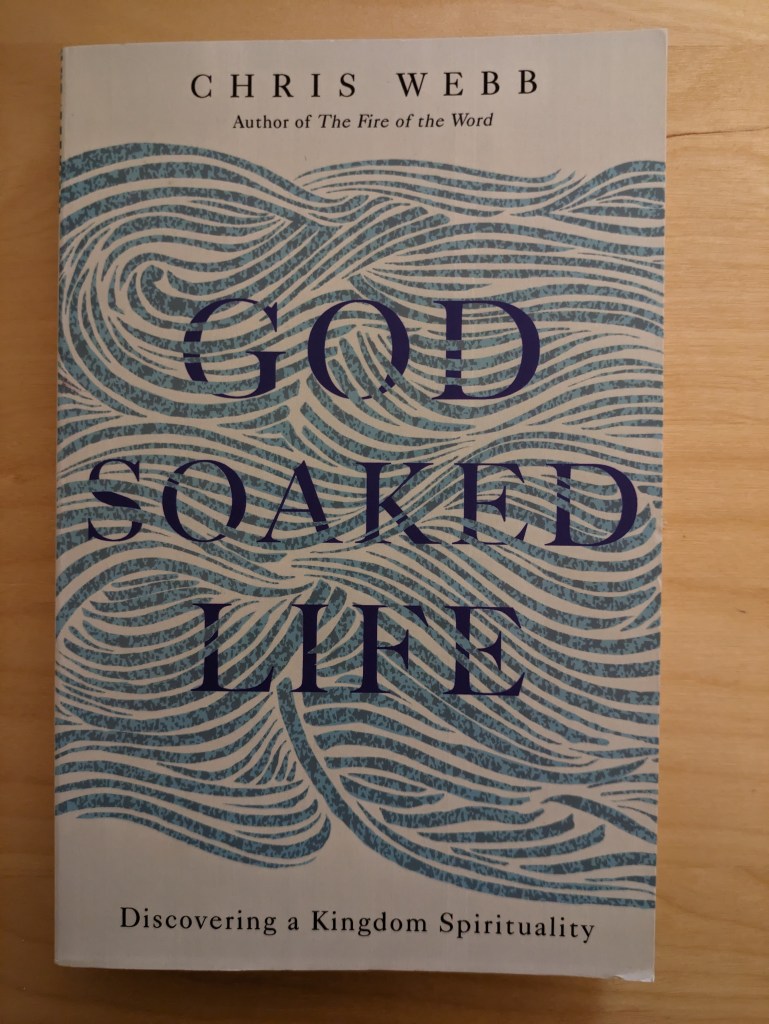
Recommended Read: God Soaked Life

If you’re looking for a book which helps you to encounter more of God – then this could just be what you’re looking for.

God Soaked Life, by Chris Webb, begins with an imaginative parable which paints a scene of life with God as living in a ‘unifying presence of the community of love’, setting the scene for the rest of the book.

Through the journey of the book, Webb highlights the invitational nature of scripture, where he suggests God is inviting us to live and love in community. We are all a work in progress, none of us are ever perfect, but regardless, we are valued in God’s Kingdom community. God’s love overflows for us, and God invites us to overflow in love for others – simple because we love as God loves.

Webb encourages us to embrace the vulnerability of honestly, in prayer, in community, in relationship with God, and accept God’s invitation to live a life soaked in God, day, by day, day. And as we do, we discover just how deeply God is already in all things.

I found reading God Soaked Life by Chris Webb an easy, yet riveting and enlightening read, that reframed and deepened my own understanding of what it means to live in relationship with God. Living a life of God Soaked Love, God Soaked community, God Soaked Life.


God Soaked Life: Discovering a Kingdom Spirituality, by Chris Webb is published by Hodder Faith.

ISBN: 9781473665286


The below service from leatherhead Methodist Church includes me preaching with reference to this book, in particular the opening imaginative parable.

Where I want to live.

I want to live in a world which cares for the lost and the lonely.
Which gives company to the isolated.
That gives hope to the displaced.
That gives welcome to the marginalised.

I want to live in a world that looks after creation.
A world that cares for the planet,
With people who are attentive to how waste is disposed of,
In community which thinks about what world it is leaving for the next generation.

I want to live in a world where people live in peace,
Not just striving for it, not just hoping for it,
Not just holding peace as a golden, yet unattainable aspiration
But wholeheartedly embracing the challenge of living in peace.
Living it out within their communities,
with friends and enemies,
Family and neighbours,
Those we love, and those we struggle to love.

I want to live in a community of love.
Where grace and forgiveness are present in abundance,
A society where sacrificial hospitality and costly generosity are always practiced.
A community which lives in perpetual gratitude and thankfulness.
A community which lives in equality and equity.
Where all human beings are given the dignity and worth that they deserve.

What sort of world do you want to live in?
What sort of society do you want to be part of?
What values do you hope it would live by?

I want to live in a God-soaked community.
A community of love. Of truth. Of hope. Of peace.


An extract from a beginning of sermon for Sunday 12th November 2023, Remembrance Sunday.